Safety starts with Safety Pole
Understanding the Six-Foot Rule, Protective Systems, and Contractor Responsibilities
Regulatory references reviewed November 19, 2026.
Federal OSHA generally requires workers engaged in residential construction to have fall protection when working six feet or more above a lower level. The employer must select an appropriate protective method and ensure that the equipment and procedures are in place before exposed work begins.
Residential construction presents changing fall hazards as floors, walls, and roof structures are assembled. During framing, the location of an unprotected edge may advance with the work, while changes in elevation introduce different anchorage and access considerations.
Federal OSHA addresses these exposures through construction fall-protection standards intended to protect workers throughout the building process.
The principal requirements appear in 29 CFR Part 1926, Subpart M.
Four sections provide the foundation:
§1926.500: Scope, applicability, and regulatory definitions.
§1926.501: Conditions and activities requiring fall protection.
§1926.502: Performance and use criteria for protective systems.
§1926.503: Employee fall-hazard training requirements.
Other federal construction provisions address specific operations, including scaffolding, ladders, and steel erection.
States administering OSHA-approved occupational safety and health programs may impose additional or different requirements. Contractors must determine which jurisdictional rules govern their projects.
Under §1926.501(b)(13), employees engaged in residential construction activities six feet or more above lower levels must be protected by guardrail systems, safety nets, or personal fall arrest systems, unless another provision authorizes an alternative method.
OSHA interprets residential construction as work satisfying two conditions: the structure’s intended use is a dwelling, and it is constructed using traditional wood-frame construction materials and methods, including qualifying light-gauge steel framing.
Section 1926.501 also addresses leading edges, floor openings, unprotected sides, and other hazardous conditions.
Six feet describes vertical fall exposure. It does not mean that work becomes automatically safe whenever an employee remains six feet horizontally from an edge.
The appropriate method depends on the work and the regulation governing the exposure.
Common protective systems include guardrails, safety nets, and personal fall arrest systems. Other measures, including properly configured restraint systems, may be acceptable under applicable OSHA interpretations and circumstances.
A personal fall arrest system must be arranged to stop a fall without allowing the employee to strike a lower level or obstruction. Its design and use involve compatible equipment, suitable anchorage, inspection, and sufficient fall clearance.
OSHA §1926.502 also establishes requirements for horizontal lifelines, including qualified-person supervision.
These considerations matter during residential framing because a protective arrangement suitable for one elevation or work area may not remain appropriate as the structure progresses.
Federal OSHA recognizes limited circumstances in which conventional fall protection may be infeasible or create a greater hazard.
For qualifying residential construction, the employer may use an alternative plan under §1926.502(k), but only after demonstrating that the regulatory conditions are satisfied.
The plan must be developed specifically for the site by a qualified person, maintained at the jobsite, and implemented under competent-person supervision.
It must explain why conventional protection cannot be used and identify the alternative measures needed to address the particular hazards.
An alternative plan is not a general exemption from fall-protection requirements. Cost, convenience, or a preference for faster construction does not independently establish infeasibility.
Providing equipment is only part of an employer’s responsibility.
Under §1926.503, employers must ensure affected employees receive training in recognizing fall hazards and understanding the appropriate protective procedures.
Employers must also maintain required training certification and provide retraining when changing conditions, equipment, or employee performance make it necessary.
Section 1926.502 requires personal fall arrest equipment to be inspected before use, damaged or defective components to be removed from service, and prompt rescue or self-rescue provisions to be established.
The resulting program must address the work being performed, not simply the equipment available on the jobsite.
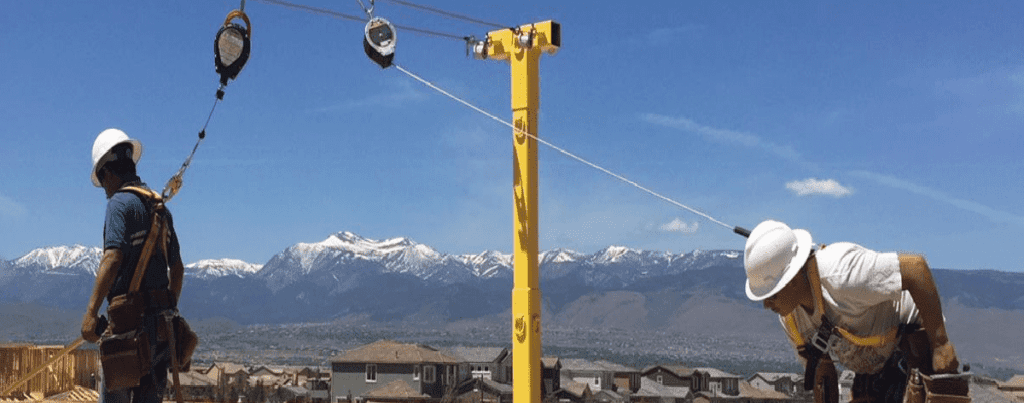
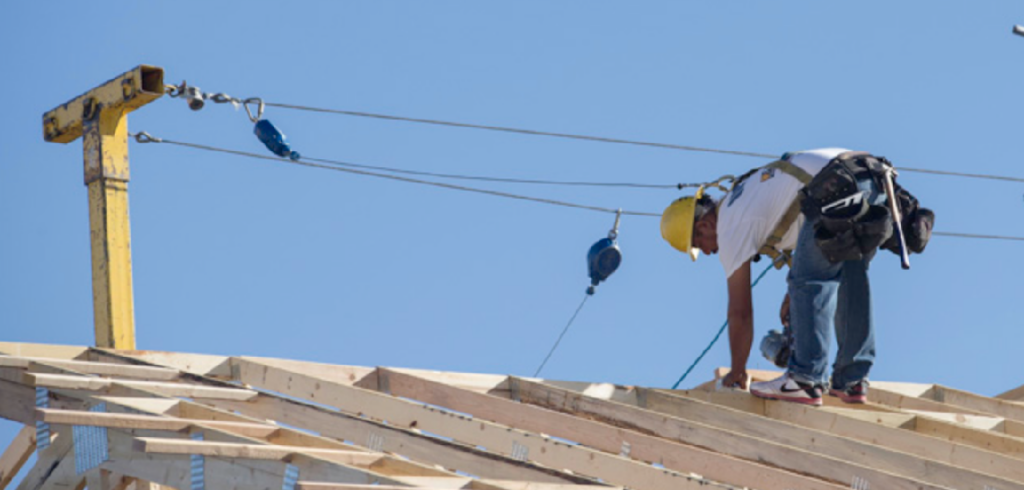
The Safety Pole System provides modular, engineered fall-protection infrastructure for defined construction applications.
Contractors can consider approved Single Anchor or Horizontal Lifeline (HLL) configurations when planning suitable anchorage locations for elevated work.
This allows anchorage needs to be evaluated alongside the construction sequence, supporting structure, worker movement, and anticipated changes in working elevation.
The Safety Pole System is designed to support OSHA-compliant fall protection when properly installed and used as directed as part of a complete fall-protection program.
The suitability of a particular arrangement depends on current manufacturer instructions, approved configurations, compatible equipment, site conditions, and the applicable regulatory requirements.
Safety Pole does not replace employer training, competent supervision, inspection, rescue arrangements, or the need for project-specific technical evaluation.
Yes, where the activity and exposure fall within the applicable residential construction or other construction provisions. Contractors must consider the actual working surface and protective method.
Only under specific provisions permitting monitoring or an authorized alternative fall-protection plan. Monitoring is not a general replacement for conventional protection.
The relevant construction standards establish requirements for systems and their use. Safety Pole does not represent its products as OSHA-approved or OSHA-certified.
Yes. Federal §1926.502(d)(20) requires prompt rescue after a fall or assurance that workers can rescue themselves.
Effective fall-protection planning begins by identifying where employees will be exposed, determining the applicable requirements, and evaluating how protection will remain suitable as construction advances.
For system information, visit the Safety Pole Documentation Hub or discuss your planned application with Safety Pole.
Compliance Statement
Safety Pole is one component of a complete fall-protection program. Regulatory compliance depends on the actual system configuration and installation, compatible equipment, worker training, inspection, supervision, maintenance, site conditions, and all applicable federal, state, local, and project requirements. Use of the Safety Pole System does not, by itself, establish employer or worksite compliance.
Understand federal OSHA’s residential construction fall-protection requirements, including when protection is necessary, which systems are permitted, and the responsibilities contractors must address.
Explore California’s construction fall-protection regulations, including the state’s six-foot requirements for specified residential framing and roofing activities and the distinctions that affect different types of work.
Learn how Cal/OSHA’s residential framing regulations apply to work on top plates, joists, trusses, and roof sheathing—and what contractors need to consider before crews work at height.
Understand the employer’s responsibilities for worker training, supervision, and documentation under OSHA and Cal/OSHA, and how manufacturer resources support those obligations.
Effective fall protection begins before work at height. Explore resources for preparing site-specific plans, assigning safety responsibilities, and maintaining equipment inspection records.
Find explanations of common fall-protection questions, technical terminology, and the regulations behind construction safety requirements. These resources help contractors locate and understand the information relevant to their work.
Learn how the Safety Pole System supports planned fall-protection arrangements as part of an employer-managed safety program. Explore our standards-driven approach, manufacturer documentation, and resources for evaluating your project’s requirements.