Safety starts with Safety Pole
Understanding OSHA, Cal/OSHA, Employer Responsibilities, and the Safety Pole System
Regulatory references reviewed: November 19, 2026.
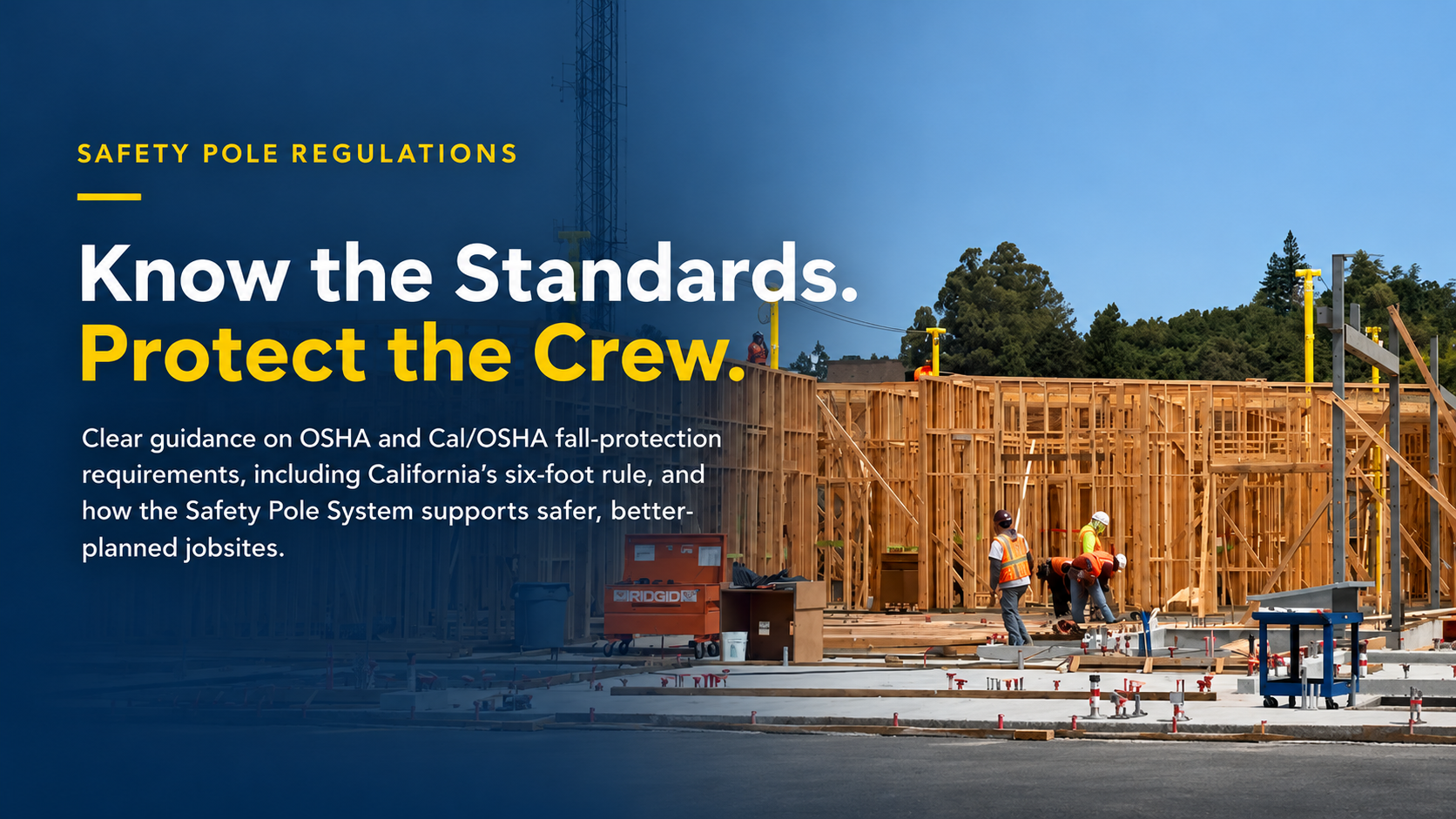
Fall protection involves more than selecting equipment or identifying a height at which a worker must tie off. Contractors must understand which regulations apply to their work, what protective measures are permitted, who is responsible for training and oversight, and how protection must be maintained as construction progresses.
Federal OSHA and California’s Cal/OSHA program address many of the same hazards, but their requirements are not identical. Differences in construction activities, fall-height thresholds, equipment arrangements, and permitted alternatives can affect how contractors plan and carry out their work.
The following questions address common concerns encountered by framing contractors, general contractors, and jobsite safety professionals. They also explain where manufacturer documentation and the Safety Pole System fit within an employer-managed fall-protection program.
Federal OSHA establishes workplace safety requirements under the Occupational Safety and Health Act. Construction fall protection is principally addressed by 29 CFR Part 1926, Subpart M, which establishes requirements for fall hazards, protective systems, and worker training.
California administers its own federally approved occupational safety and health program through the Division of Occupational Safety and Health, commonly known as Cal/OSHA. Its construction regulations appear primarily in Title 8 of the California Code of Regulations, Subchapter 4.
Although the two programs address similar hazards, California has adopted provisions that differ from federal requirements. These include certain fall-height thresholds, residential framing and roofing provisions, and system inspection obligations.
For contractors, the important consideration is jurisdictional applicability. A regulation used on a project elsewhere in the country should not automatically be assumed to govern identical work in California.
Regulatory references: Federal OSHA Subpart M | California Construction Safety Orders
Federal OSHA generally requires fall protection for residential construction workers exposed to falls of six feet or more above a lower level under §1926.501(b)(13).
California’s amendments effective July 1, 2025, established six-foot requirements for specified residential-type framing and roofing operations.
Under California §1716.2, qualifying elevated framing activities—including work on top plates, joists, rafters, and trusses—are subject to specific six-foot provisions.
Under §1731, qualifying residential roofing on slopes from 0:12 through 7:12 requires protection at a fall distance of six feet or more. Roofing on slopes greater than 7:12 requires prescribed protection regardless of height.
California also has other requirements. For example, §1670(a) addresses certain exposures exceeding seven and one-half feet, while other operations may require protection at different heights.
The six-foot threshold is a vertical fall-exposure measurement, not a general permission to work within six feet horizontally of an unprotected edge.
Regulatory references: OSHA §1926.501 | Cal/OSHA §1716.2 | Cal/OSHA §1731
Not necessarily. The distinction is especially important in California.
Residential-type framing under §1716.2 covers specified structural operations, including constructing elevated floors, installing top plates, setting joists and trusses, installing rafters, and placing roof sheathing.
Residential-type roofing under §1731 generally concerns roofing and reroofing work, including roof-covering materials and associated components. Structural roof-deck construction is excluded from that roofing definition.
This means an employee installing roof sheathing may be governed by different provisions from an employee subsequently installing shingles or other roof-covering material on the completed deck.
The applicable standards determine when protection is necessary and which methods may be used.
Contractors should evaluate the particular operation rather than assume that everyone working near the roof falls under the same regulatory provision.
Regulatory references: Cal/OSHA §1716.2 | Cal/OSHA §1731
The method selected depends on the work and the applicable regulation.
Common forms of protection include guardrail systems, safety nets, scaffolding, personal fall arrest systems, and appropriately configured fall restraint systems where permitted.
These methods serve different purposes.
A guardrail provides a physical barrier between employees and a fall exposure.
A personal fall arrest system is designed to stop a fall after it begins. Such a system generally includes a suitable anchorage, compatible connectors, a body harness, and other necessary components.
A personal fall restraint system restricts an employee’s movement so that the employee cannot reach the fall hazard.
Other methods, including safety monitoring and controlled-access zones, are subject to specific regulatory restrictions and cannot automatically replace conventional protection.
An employer must consider the working surface, structural conditions, equipment compatibility, fall clearance, and other relevant hazards before selecting a method.
The presence of an anchorage point alone does not establish that the complete protective arrangement is suitable.
Regulatory references: OSHA §1926.502 | Cal/OSHA §1670
Federal OSHA and Cal/OSHA permit alternative fall-protection plans under specified circumstances, but these plans are not general substitutes for conventional protective systems.
Under federal §1926.502(k), an alternative plan may be used for qualifying operations when an employer demonstrates that conventional protection is infeasible or would create a greater hazard.
California §1671.1 likewise requires the employer to establish the basis for using an alternative plan.
A regulated alternative plan must address the actual worksite and document why conventional measures cannot be used. It must also identify the measures intended to reduce or control the exposure.
The plan must be prepared by a qualified person, maintained at the jobsite, and implemented under competent-person supervision.
Cost, inconvenience, or a preference for faster work does not independently justify using an alternative plan.
A general company safety plan or project planning worksheet should not be confused with the specific alternative plan required by these provisions.
Regulatory references: OSHA §1926.502(k) | Cal/OSHA §1671.1
A useful project-specific plan begins with the anticipated construction sequence.
Contractors should identify where employees will work, which activities involve potential falls, and when protective arrangements must be established.
For residential framing, this often means evaluating elevated floor edges, wall construction, structural members, openings, truss and rafter installation, and roof sheathing.
A planning document can identify the protective method selected for each relevant activity, personnel responsible for implementation, applicable manufacturer instructions, and required equipment inspections.
Where personal fall-protection systems are used, the plan should also consider suitable anchorages, compatible connecting equipment, fall clearance, swing-fall exposure, and rescue arrangements.
The plan should identify who will review protection when the structure advances or the working conditions change.
If the employer intends to use a regulated alternative plan, the additional requirements of the applicable federal or California standard must be satisfied.
A standardized planning template can support consistent preparation, but the completed document must reflect the actual project.
Related resource: Residential Framing Fall-Protection Plan & Template, E3 (publication pending).
Regulatory references: OSHA §1926.502(k) | Cal/OSHA §1671.1
The employer is responsible for ensuring that employees receive the training required for the fall hazards and protective systems they will encounter.
Under federal OSHA §1926.503, affected employees must be trained to recognize fall hazards and understand the procedures used to minimize them.
The training must cover relevant protective systems, their correct use, the nature of the hazards involved, and the responsibilities assigned to employees under applicable procedures.
California §1716.2(j) establishes training requirements for specified residential framing activities. Section 1731(d) addresses hazards particular to residential roofing.
California §1509 also requires construction employers to maintain an Injury and Illness Prevention Program consistent with §3203 and to conduct toolbox, tailgate, or equivalent crew safety meetings at least every ten working days.
Training must correspond to the work employees actually perform. Introducing a different system or changing work conditions may create additional instructional needs.
Manufacturer resources can support training, but the employer remains responsible for determining and meeting the applicable training requirements.
Regulatory references: OSHA §1926.503 | Cal/OSHA §1716.2 | Cal/OSHA §1509
No. Viewing an instructional video does not, by itself, establish that an employee has satisfied applicable regulatory training requirements.
Manufacturer videos and written instructions help explain equipment identification, intended use, and the procedures associated with particular system configurations.
These materials can form part of an employer’s instructional resources. They do not replace hazard recognition, jobsite-specific instruction, appropriate supervision, or verification that employees understand how to use their assigned protective systems.
Federal §1926.503 assigns the employer responsibility for ensuring training is provided by a competent person qualified in the required subject areas.
Training must address the actual equipment and conditions employees encounter.
Likewise, completing a manufacturer demonstration does not automatically designate an employee as a competent person or establish qualified-person status for engineering or technical decisions.
Safety Pole provides available manufacturer materials through its Documentation Hub, including system references and installation media.
The employer determines how those resources are appropriately incorporated into its training program.
Regulatory reference: OSHA §1926.503
Federal OSHA §1926.503(b) requires employers to maintain a written certification of fall-hazard training.
The certification identifies the employee, the training date or dates, and the signature of the person who conducted the training or the employer.
The latest training certification must be maintained.
Retraining is required when the employer has reason to believe an employee no longer possesses the necessary understanding or skill. This can result from changes in work conditions, different protective equipment, or observed deficiencies in the employee’s use of the system.
California’s Injury and Illness Prevention Program requirements under §3203 establish additional training documentation obligations, including records identifying employees, training dates, subjects, and providers. Applicable retention requirements and exceptions must also be observed.
A useful training record should identify the instruction actually provided rather than merely record attendance.
Employers should distinguish training documentation from equipment inspection records, manufacturer manuals, and qualification records. These serve different purposes.
Regulatory references: OSHA §1926.503(b)–(c) | Cal/OSHA §3203
Federal OSHA defines these roles separately under §1926.32.
A competent person is capable of recognizing existing and foreseeable hazards and has authority to take prompt corrective measures.
A qualified person has demonstrated the knowledge, training, experience, credentials, or professional standing needed to resolve problems relating to a particular subject or technical activity.
A competent person may oversee designated field safety procedures, recognize unsafe conditions, and direct corrective action where authorized.
A qualified person may be required for specific design or technical responsibilities, including horizontal lifeline arrangements and the preparation of regulated alternative fall-protection plans.
One person may satisfy both roles when appropriately qualified and authorized, but the designations are not interchangeable.
An employer should identify the person responsible for each required function and verify that the individual’s actual qualifications and authority correspond to the task.
Manufacturer training, years of experience, or a job title alone should not be treated as universal evidence of qualification.
Regulatory references: OSHA §1926.32 | OSHA §1926.502
Personal fall arrest systems must be inspected before each use for wear, damage, deterioration, or other defects. Defective components must be removed from service.
Federal OSHA addresses these requirements under §1926.502(d).
California §1670(b)(19) additionally requires each personal fall arrest system to be inspected by a competent person at least twice annually, in accordance with manufacturer recommendations, with inspection dates documented.
Equipment subjected to fall-arrest impact loading requires special attention. Federal regulations require its immediate removal from service, and any return to use must satisfy the applicable inspection and suitability requirements. Manufacturer instructions may impose additional restrictions.
Both federal OSHA and Cal/OSHA require prompt rescue following an arrested fall or assurance that employees can rescue themselves.
Rescue arrangements should therefore be considered before an employee begins work using personal fall arrest equipment.
For Safety Pole applications, inspections and maintenance must follow the current manufacturer documentation applicable to the actual system configuration. A generic checklist or inspection record cannot replace those instructions.
Regulatory references: OSHA §1926.502(d) | Cal/OSHA §1670
No. The use of Safety Pole equipment does not independently establish employer or worksite compliance.
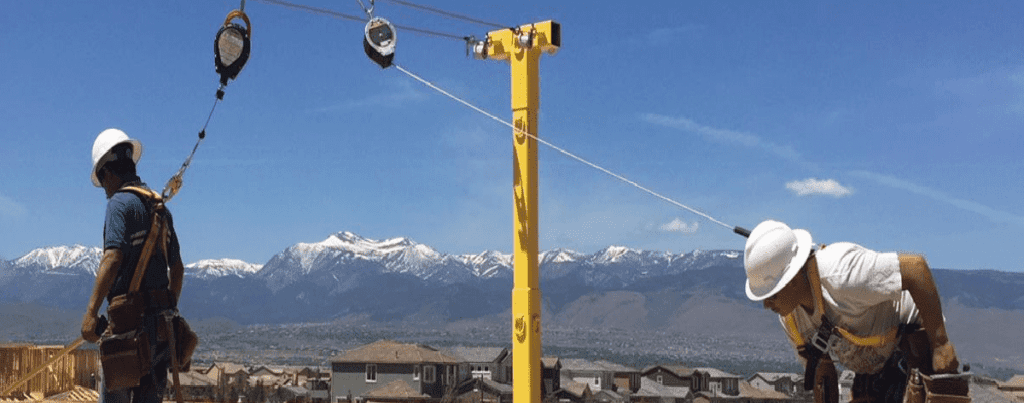
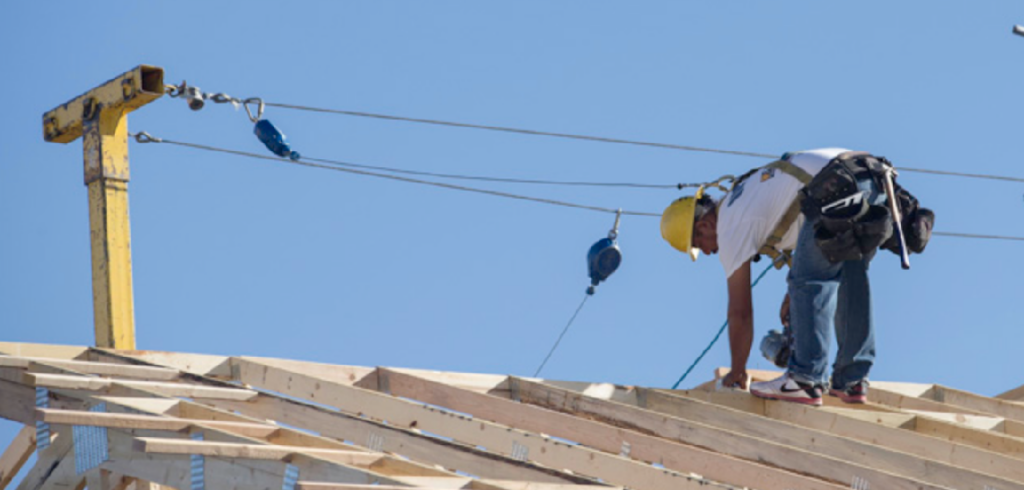
The Safety Pole System provides modular, engineered fall-protection infrastructure for defined construction applications.
The system supports approved Single Anchor and Horizontal Lifeline (HLL) deployment arrangements, subject to applicable manufacturer documentation and technical requirements.
The Safety Pole System is designed to support OSHA-compliant fall protection when properly installed and used as directed as part of a complete fall-protection program.
Actual compliance depends on the requirements governing the worksite and the complete protective arrangement. This includes the supporting structure, system configuration, compatible personal equipment, installation, training, supervision, inspection, and maintenance.
Safety Pole does not represent its products as OSHA-approved or OSHA-certified. Nor does the qualified OSHA-compliance description independently establish conformity with every applicable California requirement.
Contractors must evaluate the proposed application within their own employer-managed safety programs.
For system documentation, visit the Safety Pole Documentation Hub. For questions about a planned construction application, contact Safety Pole.
The questions above provide general explanations of common contractor responsibilities. For more detailed information, consult the related Safety Pole guides on federal OSHA residential fall protection, Cal/OSHA residential framing and roofing, alternative fall-protection planning, and the Fall-Protection Glossary.
The accompanying Regulatory References & Source Notes resource identifies the underlying regulatory provisions, official publications, and relevant amendment dates.
Compliance Statement
Safety Pole is one component of a complete fall-protection program. Regulatory compliance depends on the actual system configuration and installation, compatible equipment, worker training, inspection, supervision, maintenance, site conditions, and all applicable federal, state, local, and project requirements. Use of the Safety Pole System does not, by itself, establish employer or worksite compliance.
Understand federal OSHA’s residential construction fall-protection requirements, including when protection is necessary, which systems are permitted, and the responsibilities contractors must address.
Explore California’s construction fall-protection regulations, including the state’s six-foot requirements for specified residential framing and roofing activities and the distinctions that affect different types of work.
Learn how Cal/OSHA’s residential framing regulations apply to work on top plates, joists, trusses, and roof sheathing—and what contractors need to consider before crews work at height.
Understand the employer’s responsibilities for worker training, supervision, and documentation under OSHA and Cal/OSHA, and how manufacturer resources support those obligations.
Effective fall protection begins before work at height. Explore resources for preparing site-specific plans, assigning safety responsibilities, and maintaining equipment inspection records.
Find explanations of common fall-protection questions, technical terminology, and the regulations behind construction safety requirements. These resources help contractors locate and understand the information relevant to their work.
Learn how the Safety Pole System supports planned fall-protection arrangements as part of an employer-managed safety program. Explore our standards-driven approach, manufacturer documentation, and resources for evaluating your project’s requirements.