Safety starts with Safety Pole
Understanding California’s Construction Fall-Safety Standards
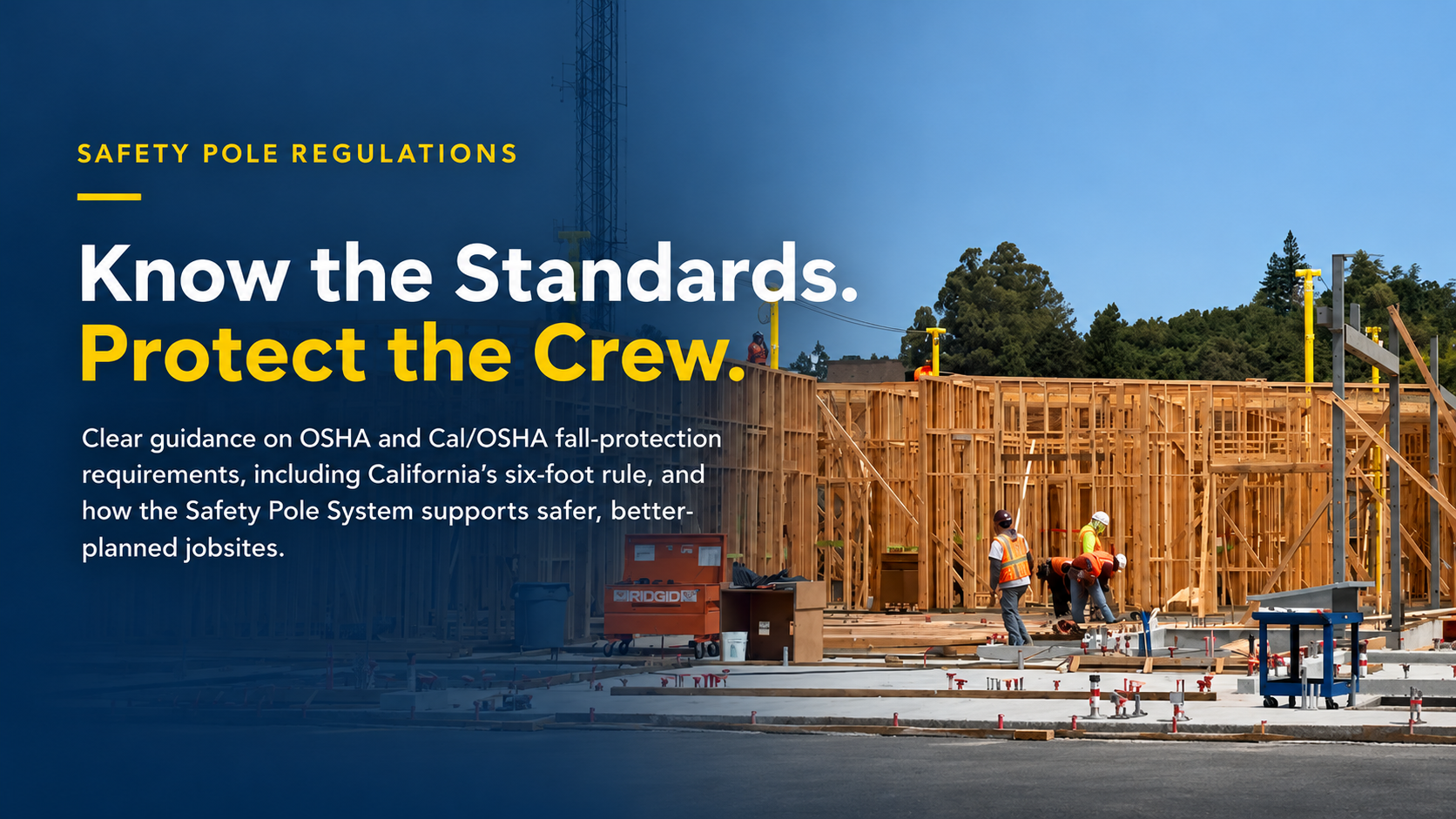
California construction fall-protection requirements depend on the work being performed, the potential fall exposure, and the specific Title 8 regulation that applies. For specified residential framing and roofing activities, the six-foot requirements effective July 1, 2025, are especially important.
California maintains its own occupational safety and health standards through Cal/OSHA. For contractors operating in the state, these requirements govern how fall hazards must be addressed during construction, including the selection of protective methods, employee training, equipment use, and jobsite oversight.
Knowing which regulation applies is essential. A framing crew, roofing contractor, and structural steel installer may work at similar elevations while being subject to different provisions.
California’s construction fall-protection requirements appear throughout the California Code of Regulations, Title 8, Subchapter 4, Construction Safety Orders.
Several provisions are particularly relevant:
Section 1670 — Personal Fall Arrest and Restraint Systems establishes requirements addressing personal fall-protection equipment, anchorages, horizontal lifelines, inspection, and rescue.
Section 1716.2 — Residential-Type Framing Activities addresses fall protection during specified wood and light-gauge steel framing operations, including elevated structural framing and roof sheathing.
Section 1731 — Residential-Type Roofing Activities governs qualifying residential roofing and reroofing work, with requirements that vary by roof slope and fall height.
Other provisions apply to nonresidential roofing, scaffolding, openings, and particular construction methods.
The correct starting point is the activity and exposure—not an assumed height threshold.
California’s residential construction amendments became effective July 1, 2025.
Under Section 1716.2, employees performing specified residential-type framing activities at six feet or more above the surrounding grade or floor below must receive fall protection through a method permitted by the regulation.
Section 1731 establishes a six-foot trigger for qualifying residential-type roofing on roofs with slopes from 0:12 through 7:12. On slopes greater than 7:12, prescribed protection is required regardless of height.
The six-foot measurement concerns vertical fall exposure, not a universal horizontal distance from an unprotected edge.
California does not impose one six-foot threshold on every construction operation. For example, Section 1670(a) contains a general personal-fall-protection provision addressing specified exposures exceeding seven and one-half feet. More specific regulations may require protection earlier.
Understanding these distinctions prevents contractors from relying on the wrong rule for the work underway.
California distinguishes construction of the structural roof from installation of roofing materials.
Setting roof trusses, installing rafters, placing roof sheathing, and related structural work fall within residential-type framing activities addressed by Section 1716.2.
Roofing and reroofing operations involving roof coverings and associated materials are addressed by Section 1731 when they meet that section’s definition.
This distinction affects which rules govern the work, including permitted protective methods and specific operating conditions.
For a closer examination, see the companion guide, What California Framers Need to Know About Cal/OSHA.
Depending on the applicable operation, California regulations provide for protective methods that can include guardrail systems, safety nets, scaffolding, and personal fall-protection systems.
Where personal fall arrest is selected, the complete arrangement must satisfy the applicable criteria for anchorages, equipment compatibility, arrest performance, fall clearance, and rescue.
Section 1670 requires horizontal lifelines to be designed, installed, and used under qualified-person supervision as part of a complete personal fall arrest system maintaining the specified safety factor.
Alternative fall-protection plans are permitted only under defined regulatory conditions. Under Section 1671.1, the employer bears the burden of establishing when conventional fall protection is infeasible or creates a greater hazard. The required plan must address the actual worksite and comply with its applicable provisions.
A written plan does not independently authorize safety monitoring or controlled-access procedures in place of conventional protection.
Employers must identify applicable hazards and implement protective measures appropriate to the work.
California Section 1509 requires an Injury and Illness Prevention Program consistent with Section 3203, along with a written Code of Safe Practices and prescribed safety meetings.
Depending on the operation and equipment, contractors must also ensure employee fall-hazard training, competent-person supervision, qualified-person involvement, inspection, and prompt rescue arrangements.
For personal fall arrest systems, Section 1670 specifies inspections before use and competent-person inspections at least twice annually, with dates documented.
These requirements continue throughout the job. Changes in elevations, work locations, structural conditions, or equipment arrangements may require a fresh evaluation.
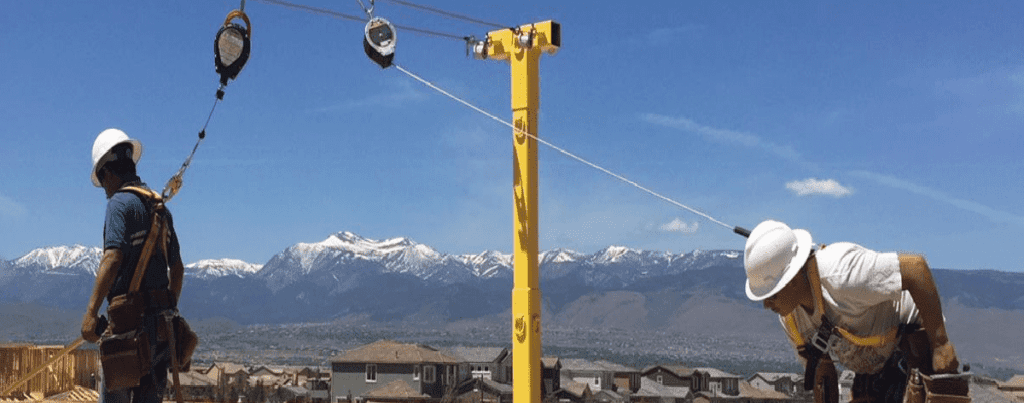
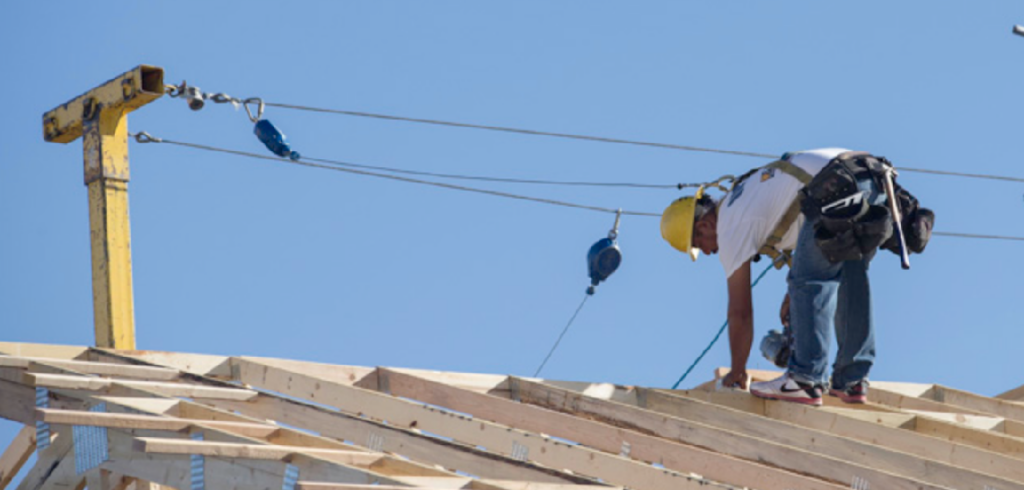
The Safety Pole System provides modular, engineered fall-protection infrastructure for defined construction applications.
Its Single Anchor and Horizontal Lifeline (HLL) deployment arrangements can be considered during project planning, allowing contractors to evaluate potential anchorage locations alongside anticipated work sequences and exposure conditions.
The Safety Pole System is designed to support OSHA-compliant fall protection when properly installed and used as directed as part of a complete fall-protection program.
Its use does not independently establish compliance with Cal/OSHA. The applicable California requirements, approved system configuration, supporting structure, compatible equipment, and jobsite conditions must be evaluated for each application.
No. The six-foot requirements apply to specified activities, including residential-type framing and roofing. Other operations may have different thresholds or requirements.
Only where the governing regulation permits an alternative and its prescribed conditions are satisfied. Safety monitoring is not a general substitute for conventional fall protection.
Yes. Section 1670(b)(2) establishes qualified-person supervision and complete-system criteria for horizontal lifelines used within personal fall arrest systems.
No. Equipment selection and installation are components of an employer-managed fall-protection program. Actual compliance depends on the complete arrangement and applicable worksite requirements.
Contractors should identify anticipated fall exposures before elevated work begins, determine the governing regulation, and select an appropriate protective method.
For information about Safety Pole configurations and their potential application to planned construction work, consult the Safety Pole Documentation Hub or discuss your project with Safety Pole.
Compliance Statement
Safety Pole is one component of a complete fall-protection program. Regulatory compliance depends on the actual system configuration and installation, compatible equipment, worker training, inspection, supervision, maintenance, site conditions, and all applicable federal, state, local, and project requirements. Use of the Safety Pole System does not, by itself, establish employer or worksite compliance.
Understand federal OSHA’s residential construction fall-protection requirements, including when protection is necessary, which systems are permitted, and the responsibilities contractors must address.
Explore California’s construction fall-protection regulations, including the state’s six-foot requirements for specified residential framing and roofing activities and the distinctions that affect different types of work.
Learn how Cal/OSHA’s residential framing regulations apply to work on top plates, joists, trusses, and roof sheathing—and what contractors need to consider before crews work at height.
Understand the employer’s responsibilities for worker training, supervision, and documentation under OSHA and Cal/OSHA, and how manufacturer resources support those obligations.
Effective fall protection begins before work at height. Explore resources for preparing site-specific plans, assigning safety responsibilities, and maintaining equipment inspection records.
Find explanations of common fall-protection questions, technical terminology, and the regulations behind construction safety requirements. These resources help contractors locate and understand the information relevant to their work.
Learn how the Safety Pole System supports planned fall-protection arrangements as part of an employer-managed safety program. Explore our standards-driven approach, manufacturer documentation, and resources for evaluating your project’s requirements.