Safety starts with Safety Pole
Safety Pole Contractor Reference Glossary
Version 0.1 | Regulatory sources checked November 16, 2026
Scope: Federal OSHA, California Title 8 Construction Safety Orders, and Safety Pole System terminology.
This glossary explains common fall-protection terminology and selected construction situations in plain language. Terms identified as regulatory are paraphrased for readability; the official regulations remain controlling.
OSHA — Occupational Safety and Health Administration
Regulatory agency. The federal agency responsible for administering and enforcing occupational safety and health standards. Federal construction fall-protection provisions are principally found in 29 CFR Part 1926, Subpart M.
Cal/OSHA — California Division of Occupational Safety and Health
Regulatory agency. California’s occupational safety and health enforcement agency. Construction employers operating in California must consider applicable state Construction Safety Orders, including requirements that differ from federal rules.
Regulatory Applicability
Regulatory concept. The determination of which safety standard governs a particular operation, worker exposure, and worksite. Construction type, work activity, height, surface, and other conditions may affect which provision applies.
Fall-Protection Trigger Height
Practical regulatory term. The vertical fall exposure at which a specified regulation requires protection. Trigger heights vary according to the task and applicable standard. Some operations require protection regardless of height.
Six-Foot Rule
Common regulatory shorthand. Generally refers to requirements for fall protection at a vertical exposure of six feet or more. Federal OSHA applies six feet to many construction activities; California’s July 1, 2025 amendments expressly establish six-foot requirements for specified residential-type framing and roofing operations. It is not a universal rule for every construction activity.
Seven-and-One-Half-Foot Provision
California regulatory term. California Title 8 §1670(a) establishes a general personal fall-protection requirement for specified exposures in excess of 7½ feet. Other, more specific provisions can require protection at lower heights or regardless of height.
Residential-Type Framing Activities
California regulatory definition. Construction methods involving wood or light-gauge steel framing, including floor joists, sheathing, framed walls, trusses, rafters, roof sheathing, and related work. Under §1716.2, qualifying activities may occur on residential buildings or commercial structures using residential-type framing methods.
Residential-Type Roofing Activities
California regulatory definition. Roofing or reroofing work on qualifying residential-type structures, including removal, handling, and installation of roofing materials and associated components. Construction of the structural roof deck is excluded from this roofing definition.
Roof Slope / Roof Pitch
Regulatory and construction term. The inclination of a roof expressed as vertical rise over horizontal run. A 7:12 roof rises seven units for every twelve horizontal units. Federal OSHA and California residential roofing regulations use different slope classifications.
Walking/Working Surface
Regulatory definition. A surface on which employees walk or perform work, including floors, roofs, ramps, structural framing, and other qualifying work surfaces. Different standards govern certain equipment and access methods.
Lower Level
Regulatory definition. A surface or location to which a worker could fall, including floors, ground, platforms, excavations, structures, or equipment. The relevant lower level is not necessarily the ground outside the building.
Unprotected Side or Edge
Regulatory definition. An edge of a walking or working surface lacking the protective barrier specified by the applicable standard. Such edges often create the exposure that triggers fall-protection requirements.
Leading Edge
Regulatory definition. A floor, roof, or deck edge that moves as construction progresses. Leading-edge work requires particular attention because the location and nature of the exposure change with the building sequence.
Fall Distance / Fall Height
Regulatory and practical term. The vertical distance relevant to assessing a fall hazard. California §1731 measures residential roofing fall height from the worker’s surface to the ground or lower level, without including parapet height.
Hole or Opening
Regulatory definition. A gap through a floor, roof, wall, or working surface that may expose employees to falling. Federal OSHA distinguishes holes from wall openings by dimensions. California also establishes separate requirements for guarding openings.
Roof Sheathing / Roof-Deck Construction
Construction activity. Installation of structural panels forming the roof deck. This is distinguished from placing roofing materials over the completed deck and is expressly included among California residential-type framing activities.
Gable-End Work
Construction activity. Work involving the triangular end of a pitched roof, including operations extending beyond a gable-end truss or rafter. California §1716.2(g)(2) specifically addresses fall exposure during such work.
Swing Fall
Fall-protection hazard. A pendulum-like fall that can occur when a worker is positioned horizontally away from the anchorage. Planning must consider potential contact with structural members, edges, or other obstacles.
Fall Clearance
Technical planning term. The vertical space required for a fall-arrest system to stop a falling worker before contact with a lower level or obstruction. Clearance depends on the complete system and installation geometry; it is not the same as the regulatory trigger height.
Conventional Fall Protection
Regulatory term. In the applicable federal and California alternative-plan provisions, this generally refers to guardrail systems, safety nets, and personal fall arrest systems. An employer cannot automatically substitute a written plan for these methods.
Fall Prevention
Practical term. Measures intended to prevent a worker from falling, such as appropriate guardrails or properly configured restraint systems.
Personal Fall Arrest System (PFAS)
Regulatory definition. An arrangement of anchorage, connectors, body harness, and other necessary equipment designed to stop a worker after a fall begins.
Personal Fall Restraint System
Regulatory and technical term. Equipment arranged to restrict worker movement so that the worker cannot reach the fall hazard. Restraint and arrest have different functions and performance requirements.
Guardrail System
Regulatory definition. A protective barrier intended to prevent employees from falling to a lower level. Guardrails must satisfy applicable installation and performance criteria.
Safety Net System
Regulatory definition. A system positioned to catch employees who fall from an elevated work area. Nets are subject to specific installation, strength, clearance, and inspection requirements.
Scaffolding
Regulated access equipment. A temporary elevated platform and supporting structure used to provide workers with access and a working surface. Scaffold requirements are separately regulated; scaffolding is not necessarily interchangeable with anchorage-based fall protection.
Anchorage / Anchorage Point
Regulatory definition. A secure attachment location for lifelines, lanyards, or fall-protection devices. The anchorage and supporting structure must satisfy the requirements applicable to the complete fall-protection arrangement.
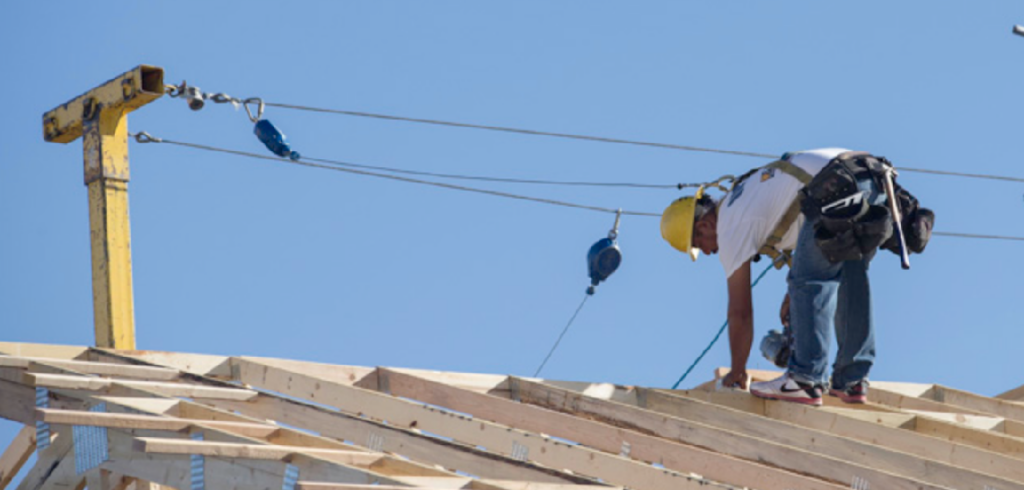
Horizontal Lifeline (HLL)
Technical and regulatory term. A lifeline extending horizontally between designed anchorage locations and used within a personal fall arrest system. Federal OSHA §1926.502(d)(8) and California §1670(b)(2) require qualified-person supervision and a system safety factor of at least two.
Body Harness / Full-Body Harness
Regulatory definition. Straps arranged around a worker to distribute fall-arrest forces over appropriate areas of the body. Body belts are not permitted for fall arrest under the cited federal standard.
Lanyard
Regulatory definition. A flexible connecting line or strap used to connect a harness to an anchorage, lifeline, or other component. Its appropriate use and performance depend on the system configuration.
Self-Retracting Lifeline (SRL)
Regulatory definition. A device that allows line movement under normal conditions and automatically locks to arrest a fall. Compatibility, installation, and clearance must be established for the intended use.
Deceleration Device / Deceleration Distance
Regulatory terms. A device that dissipates energy or limits forces during fall arrest, and the additional vertical travel while that device brings the worker to a stop.
Fall-Arrest Anchorage Criteria
Regulatory requirement. Federal §1926.502(d)(15) and California §1670(b)(10) prescribe alternative methods of establishing suitable anchorage, including a specified 5,000-pound-per-employee criterion or an engineered system maintaining a safety factor of at least two under qualified-person supervision. These provisions are not blanket load ratings for Safety Pole equipment.
Rescue Arrangements
Regulatory and planning term. Measures enabling prompt rescue after a fall has been arrested. Federal and California standards require employers to provide prompt rescue or assure that workers can rescue themselves.
Competent Person
Regulatory definition. A person capable of recognizing existing and foreseeable workplace hazards and authorized to take prompt corrective measures. Competent-person responsibilities include certain supervisory and inspection functions.
Qualified Person
Regulatory definition. A person whose education, credentials, knowledge, training, or experience demonstrates the ability to resolve problems related to the particular work or technical subject.
Authorized Person / Authorized Worker
Regulatory and operational term. An individual assigned or approved by the employer for defined activities or access. Authorization does not eliminate training, supervision, or equipment requirements.
Site-Specific Fall-Protection Plan
Regulatory term. A documented plan addressing particular conditions and controls at an individual construction site. Under alternative-plan provisions, additional prescribed requirements apply when conventional protection is infeasible or creates a greater hazard.
Infeasibility
Regulatory term. A circumstance in which conventional fall protection cannot be used to perform the work or cannot technologically provide the required protection. It is not synonymous with inconvenience or increased cost.
Greater Hazard
Regulatory concept. A situation in which using a prescribed conventional protective method would itself create a greater hazard. The employer must demonstrate the basis for using an authorized alternative.
Controlled Access Zone (CAZ)
Regulatory definition. An area where access is restricted and certain operations may occur under specifically authorized alternative fall-protection procedures. A CAZ does not independently exempt the employer from fall-protection requirements.
Safety Monitoring System
Regulatory definition. A method in which an assigned competent person observes affected workers and warns of fall hazards. Monitoring is permitted only under specified circumstances and is subject to personnel and operating restrictions.
Pre-Use Inspection
Regulatory requirement. Examination of personal fall-arrest components before each use to identify damage, deterioration, or other defects requiring removal from service.
Periodic Inspection
Regulatory and operational term. Inspection at prescribed intervals by designated personnel. California §1670(b)(19) requires competent-person inspection of each personal fall arrest system at least twice annually, in accordance with manufacturer recommendations, with dates documented.
Impact-Loaded Equipment
Regulatory term. Fall-arrest equipment subjected to forces during a fall. Federal §1926.502(d)(19) requires immediate removal from service, with return permitted only after competent-person inspection determines suitability. Manufacturer requirements may impose further restrictions.
Worker Fall-Hazard Training
Regulatory requirement. Instruction enabling employees to recognize fall hazards and understand appropriate protection procedures. Federal §1926.503 and the applicable California framing and roofing provisions establish training and documentation obligations.
These definitions follow SP-SKS-3.0 and the current Safety Pole public claims authority. They explain system identity and operating context, not unverified engineering specifications.
Safety Pole System
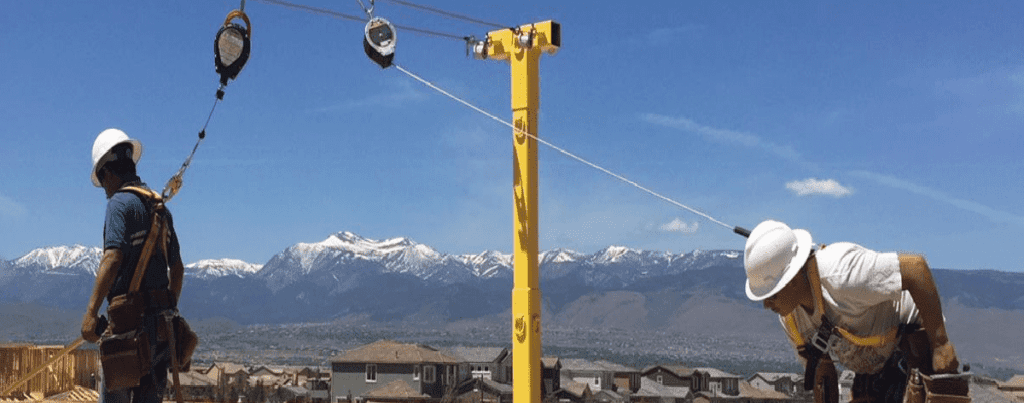
Manufacturer terminology. A modular construction fall-protection system intended to provide planned anchorage infrastructure for defined applications, as one component of a complete employer fall-protection program.
Single Anchor Deployment
Safety Pole terminology. A configuration in which an individual assembled Safety Pole vertical unit serves as a single anchorage point within an approved fall-protection arrangement.
Horizontal Lifeline Deployment
Safety Pole terminology. A multi-unit configuration in which Safety Pole vertical units support a horizontal lifeline arrangement. Connection details, user capacities, spans, and loading remain subject to applicable technical authority.
Traditional System
Safety Pole terminology. One of the manufacturer’s established system/package configurations. The designation does not independently define an application, permissible mounting condition, or worker capacity.
MUF System
Safety Pole terminology. A modular system/package configuration associated with planned progression and repositioning as construction advances. MUF describes configuration, not a separate regulatory fall-protection category.
Leapfrog
Safety Pole terminology. The approved field term for MUF progression or repositioning during construction. It does not authorize a particular relocation procedure or imply uninterrupted protection during movement.
Planned Anchorage
Operational concept. Incorporating the location and intended use of anchorage into construction planning before an elevated exposure occurs. Safety Pole is designed to support this planning approach.
Approved System Configuration
Manufacturer and engineering concept. A system arrangement established as suitable for a defined application under current manufacturer instructions and applicable technical authority. A generally available product configuration is not necessarily approved for every jobsite.
Relocation and Reconfiguration
Operational concept. Changing a fall-protection system’s location or arrangement as the construction sequence progresses, in accordance with applicable approved procedures. A moved or reconfigured system requires appropriate verification before further use.
OSHA-Compliant Fall Protection
Controlled Safety Pole claims terminology. Fall protection satisfying applicable OSHA requirements through the complete arrangement of properly selected equipment, installation, training, supervision, inspection, and use. The Safety Pole System is designed to support OSHA-compliant fall protection when properly installed and used as directed as part of a complete program. This does not constitute OSHA product approval or independently establish Cal/OSHA compliance.
These examples help readers identify relevant regulatory questions. They are not installation instructions or project-specific compliance determinations.
| Situation | Regulatory consideration |
|---|---|
| A framing employee works on a top plate six feet above the floor below. | California §1716.2(e)(1) prescribes fall protection for the specified elevated framing work. |
| A worker performs interior framing between six and fifteen feet above the lower level. | California §1716.2(e)(2) provides a narrowly conditioned alternative involving bracing, member spacing or sheathing, and distance greater than six feet from an unprotected edge. All specified conditions must be evaluated. |
| A residential roofer works on a 5:12 roof with a fall exposure of eight feet. | California §1731(c)(1) establishes a six-foot trigger for qualifying residential roofing on slopes up to and including 7:12. |
| A residential roofer works on an 8:12 roof with a fall exposure of four feet. | California §1731(c)(2) requires prescribed protection regardless of height for slopes greater than 7:12. |
| A worker installs roof sheathing before roofing materials are applied. | Roof-deck construction belongs to the framing analysis under §1716.2, rather than the residential roofing definition in §1731. |
| A contractor proposes safety monitoring instead of conventional protection. | The employer must establish that an applicable alternative is legally permitted and satisfy §§1671.1 and 1671.2 where required. |
| A construction crew plans to relocate a Safety Pole configuration to another work area. | The team must consider how protection is maintained during the transition and verify that the subsequent installation is approved and ready for use. Product relocation does not independently establish regulatory compliance. |
| A fall has occurred and the arrest equipment appears undamaged. | Appearance alone does not authorize continued use. Applicable removal-from-service and inspection requirements, along with manufacturer instructions, govern its disposition. |
Federal references
California references
Safety Pole internal authority
SP-SKS-3.0 — Current Safety Pole System Knowledge
SP-SKS-COMP-001 — OSHA Compliance Claims and Disclaimer Governance
SP-INS-2501-A — 2026 Safety Pole Installation Manual
SP System Public Claims and Terminology Matrix v3.0
Regulatory note: California’s relevant residential construction amendments became effective July 1, 2025. This date does not apply to all the federal or California provisions in the glossary.
Editorial qualification: This glossary provides general explanatory information. It does not replace current regulations, site-specific hazard assessment, qualified technical review, or manufacturer instructions.
Understand federal OSHA’s residential construction fall-protection requirements, including when protection is necessary, which systems are permitted, and the responsibilities contractors must address.
Explore California’s construction fall-protection regulations, including the state’s six-foot requirements for specified residential framing and roofing activities and the distinctions that affect different types of work.
Learn how Cal/OSHA’s residential framing regulations apply to work on top plates, joists, trusses, and roof sheathing—and what contractors need to consider before crews work at height.
Understand the employer’s responsibilities for worker training, supervision, and documentation under OSHA and Cal/OSHA, and how manufacturer resources support those obligations.
Effective fall protection begins before work at height. Explore resources for preparing site-specific plans, assigning safety responsibilities, and maintaining equipment inspection records.
Find explanations of common fall-protection questions, technical terminology, and the regulations behind construction safety requirements. These resources help contractors locate and understand the information relevant to their work.
Learn how the Safety Pole System supports planned fall-protection arrangements as part of an employer-managed safety program. Explore our standards-driven approach, manufacturer documentation, and resources for evaluating your project’s requirements.