DEDICATED TO GETTING WORKERS HOME SAFELY SINCE 2004

Engineered Fall Protection for Real-World Jobsites

Equip Your Team with Confidence

For questions, concerns, or guidance on the Safety Pole system or fall-safety implementation, contact us.

© 2004–2026 Safety Pole, Inc.

The

JOBSITE STANDARD

Built on Safety. Set as Standard. The Safety Pole Perspective

Applied Safety

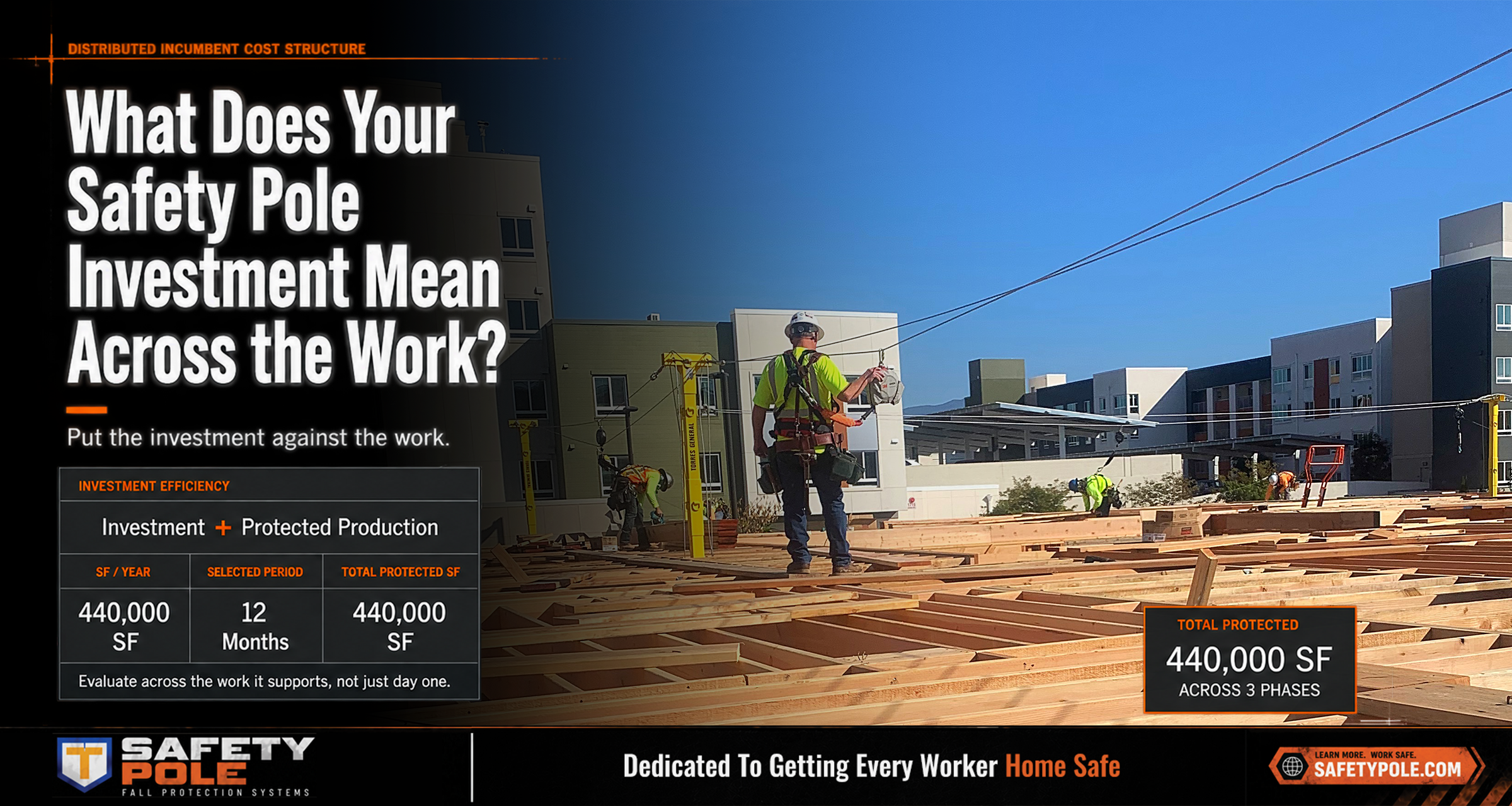
What Does Your Safety Pole Investment Mean Across the Work?

Put the project-specific acquisition against the production and costs it is expected to support.

By SP Editorial Team

Published in J.S. Case Studies, Jobsite Standard

What Does Your Safety Pole Investment Mean Across the Work?

A contractor worksheet for combining current operating costs, costs that remain, new applicable costs, a project-specific Safety Pole acquisition value, and a defined production horizon into a disciplined planning comparison.

Once you have identified the costs you already carry, the next question is not simply whether the Safety Pole acquisition number looks large or small.

The more useful question is:

What does that investment represent across the amount of work you expect it to support?

This article is designed as a worksheet. It does not publish a Safety Pole price. Instead, it gives you a structure for entering your own operating records and, when available, the project-specific Safety Pole acquisition value supplied for your evaluation.

The objective is not to manufacture an ROI number. It is to build a comparison you can later test against actual results.

Source: S.P. Graphics

Step 1 — Define the work you are evaluating

Start with the production horizon rather than the equipment price.

Record the annual framed or otherwise appropriately defined protected production you expect the equipment to support and the period you want to evaluate.

Production input Your value
Annual framed/protected production ________ SF
Selected use period ________ years
Total protected square footage over selected period ________ SF

The governed selected-horizon method is:

Total Protected Square Feet over Selected Use Period = Annual Framed Volume × Selected Use Period

The selected period is an analytical horizon. It is not a statement of Safety Pole useful life, warranty, or retirement timing.

Step 2 — Build your incumbent-cost worksheet

Use actual records where possible. Enter only the categories that genuinely belong to the work you are comparing.

Current cost category Current annual/project cost Expected to remain after change Source / note
Scaffold or temporary-access rental $________ $________ __________
Delivery / freight $________ $________ __________
Erection / initial setup $________ $________ __________
Relocation during the work $________ $________ __________
Dismantling / removal $________ $________ __________
Handling / material movement $________ $________ __________
Coordination labor $________ $________ __________
Inspection / maintenance where applicable $________ $________ __________
Storage / transport associated with current method $________ $________ __________
Other applicable current cost $________ $________ __________
Total comparable current cost $________
Total incumbent cost expected to remain $________

The goal is not to assume every current cost disappears. It is to separate the costs that may change from the costs that are expected to remain.

Step 3 — Add the operating costs of the new approach

A credible comparison also includes new applicable costs introduced by the change.

Not every category below will apply to every contractor or project. Use only the costs that belong in your model.

New/applicable operating cost Your value Source / note
Deployment labor $________ __________
Freight / transport $________ __________
Inspection $________ __________
Maintenance $________ __________
Storage $________ __________
Training where applicable $________ __________
Financing where applicable $________ __________
Other applicable operating cost $________ __________
Total new/applicable operating cost $________

Keeping these costs visible prevents the model from treating a new system as if it were free to operate after the purchase.

Step 4 — Enter the Safety Pole acquisition value when you have it

The public worksheet intentionally leaves the Safety Pole acquisition field blank.

Project-specific Safety Pole equipment investment: $________________

Use the applicable value supplied for your project or purchasing decision. Do not substitute a remembered public example, an old price sheet, or a number inferred from another contractor’s transaction.

This field is intentionally unresolved until you have a governed project-specific commercial input.

Step 5 — Put the equipment investment against production

Once you have both the acquisition value and the selected production horizon, you can calculate a simplified equipment-only cost per protected square foot.

The governed method is:

Equipment Cost per Protected SF = Equipment Investment ÷ Total Protected Square Feet over Selected Use Period

Use your worksheet values:

$________ ÷ ________ SF = $________ per protected SF

This is a simplified equipment-allocation method. It is not full total cost of ownership by itself.

A full ownership analysis may also need to account for applicable acquisition, deployment, inspection, maintenance, transport, storage, financing, replacement or retirement assumptions, residual value, and remaining scaffold or access costs.


Complete the worksheet with your own records and the applicable project-specific Safety Pole acquisition value, then preserve the assumptions for later verification.

Step 6 — Build the planning comparison

You can now compare the operating structure before and after the proposed change without treating the acquisition value as a magic answer.

A planning comparison may be structured as:

Current Comparable Cost − Incumbent Cost Expected to Remain − New Applicable Operating Cost = Modeled Operating Difference

Worksheet:

Planning comparison Your value
Total comparable current cost $________
Less: incumbent cost expected to remain − $________
Less: new/applicable operating cost − $________
Modeled operating difference $________

That result is still a projection.

It tells you what the model expects to change in the cost categories you selected. It does not prove that the difference will occur, and it should not be called verified savings or realized improvement before operating records support it.

Step 7 — Keep acquisition and operating analysis on the same time basis

One-time equipment acquisition and annual operating costs should not be mixed casually.

If you are evaluating a multi-year period, define the period and state how each input is being treated. If you are using simplified equipment cost per protected square foot, keep that method separate from a full total-cost analysis unless every material cost category required for the fuller model has actually been included.

This is one of the reasons a worksheet is useful. It makes the assumptions visible before the conclusion is written.

What should this worksheet tell you?

By the time you complete it, you should be able to answer several practical questions:

  • What comparable costs are we carrying today?
  • Which of those costs are expected to remain?
  • What new applicable operating costs would the change introduce?
  • What project-specific Safety Pole acquisition value are we evaluating?
  • How much production are we asking the equipment investment to support during the selected period?
  • What does the simplified equipment investment represent per protected square foot?
  • Which parts of the model are still assumptions rather than measured results?

If any of those answers are unclear, the model is not finished.

The worksheet is the beginning, not the conclusion

A pre-purchase analysis should help you decide what to measure after deployment.

That is the value of building the worksheet before the equipment goes to work. You establish the assumptions, categories, and expected changes in advance. Later, you can replace those assumptions with actual records instead of changing the model after the fact to fit the outcome.

The next article in the series addresses that step directly:

Did the investment actually change your costs?

Safety Pole, Inc. Use your records. Enter your project-specific investment. Then measure what actually changes.

The Jobsite Standard

Summer 2026

Jobsite Standard - Economics of the Jobsite

Applied Safety

What Does Your Safety Pole Investment Mean Across the Work?

August 9, 2026

By SP Editorial Team

Use contractor-entered inputs, keep the acquisition field project-specific, and treat the resulting operating difference as a projection until actual records verify what changed.
This Article is In the Series Capital Investment Series

Download the Worksheet

Capital Investment Contractor Worksheet
Use this worksheet alongside the Capital Investment Series to document current costs, model the proposed investment, and verify what actually changes after deployment.

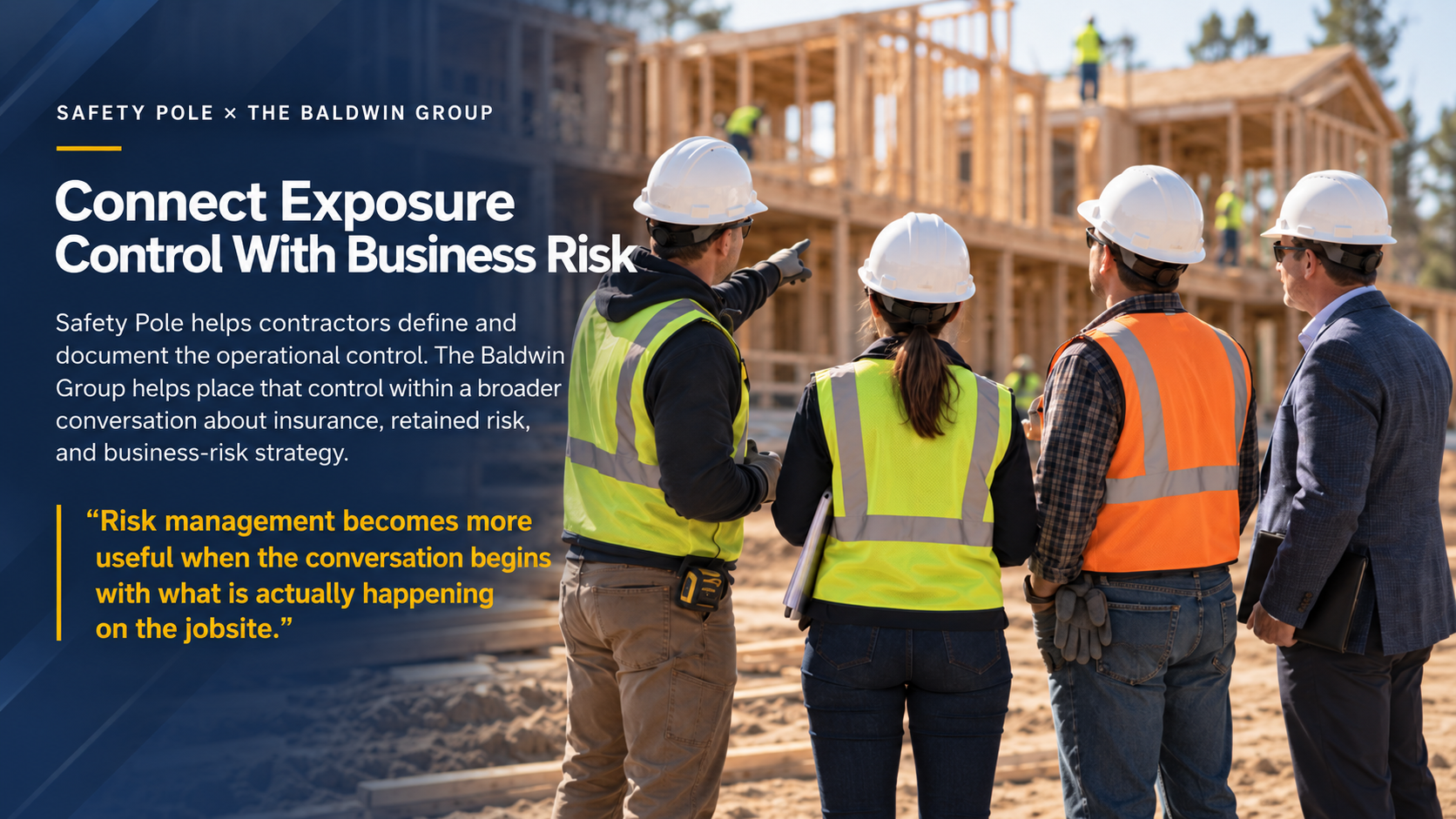
Business Risk Starts With the Work

Business risk is not only about what happens after an incident. It also includes the physical controls, planning, documentation, and operating decisions made beforehand. See where fall protection fits into that larger conversation; and why managing the exposure starts with the work itself.

If you found this article useful, you may wish to receive future issues of The Jobsite Standard. Our email edition shares selected articles, field insights, and updates on safety practices relevant to working at height.

Let's Talk About Your Jobsite

Every project presents unique challenges.

Whether you're evaluating fall protection options, planning an upcoming project, or looking for guidance on creating a safer work environment, our team is here to help.

Send us a message and a Safety Pole representative will contact you to discuss your questions and project needs.

Name
Tell us about your project, safety concerns, fall protection requirements, or any questions you have for our team.

Your information will only be used to respond to your inquiry. We do not sell or share your information with third parties.

Dedicated to Getting Workers Home Safely