
Safety starts with Safety Pole

A post-deployment verification method for replacing planning assumptions with actual contractor records, reconciling the same cost categories, and determining whether an operating-cost change is genuinely supported by evidence.
The purchase tells you what you invested.
The operating record tells you whether the investment changed anything.
Before deployment, a capital-investment model is built from assumptions: current comparable costs, costs expected to remain, new operating costs, production volume, utilization, and the acquisition value being evaluated.
After the equipment has been through the work, those assumptions should be replaced with records wherever possible.
That is the point at which the business question becomes more useful:
Did the investment actually change our cost structure?
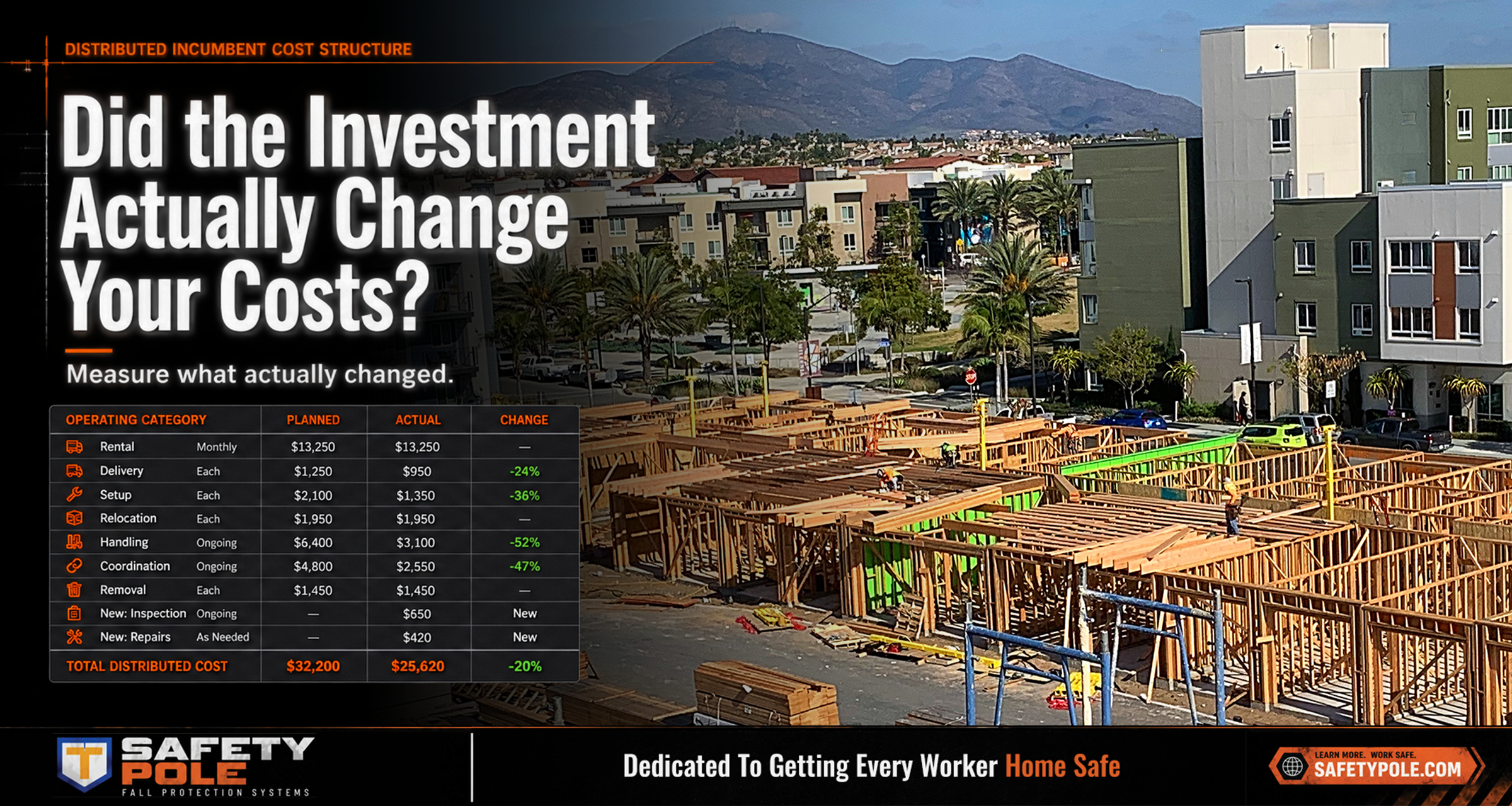
The worksheet from the previous article gives you a baseline.
You identified:
Do not rewrite those assumptions after the fact just because the actual result is different.
Use them as the comparison point.
The purpose of verification is not to prove the original projection was right. It is to learn what actually happened.
At the end of the evaluation period, pull the actual cost and production records that belong to the comparison.
Your verification worksheet should look something like this:
| Verification category | Planned | Actual | Source / note |
|---|---|---|---|
| Historical comparable cost | $________ | $________ | __________ |
| Incumbent cost expected to remain | $________ | $________ | __________ |
| New applicable operating cost | $________ | $________ | __________ |
| Actual framed/protected production | ________ SF | ________ SF | __________ |
| Utilization or deployment assumption | ________ | ________ | __________ |
| Other material input | ________ | ________ | __________ |
The important change is the source of the number.
Before deployment, the value may have been an estimate. After deployment, the same field should be supported by the contractor’s operating record if the result is going to be treated as verified.
If scaffold or another access method remained necessary for part of the work, keep that cost.
If deployment, inspection, transport, storage, maintenance, training, or another applicable operating expense occurred, include it.
If production or utilization was lower than expected, use the actual value.
Do not remove a cost because it weakens the result. Do not add a benefit because it would make the investment look better.
A credible verification process asks:
What changed?
not
How do we make the model prove what we hoped would happen?
The following is a deliberately round, fully synthetic example. It is not Safety Pole pricing, a market average, an expected contractor result, or a claim about what a project should save.
Assume the contractor’s records support:
Historical comparable annual cost: $100,000
After implementation:
The reconciled post-change operating basis is:
$55,000 + $15,000 = $70,000
The illustrative difference is:
$100,000 − $70,000 = $30,000
That arithmetic is straightforward. The authority of the result is not.
In a real contractor analysis, the $30,000 would be treated as verified realized economic improvement only if the underlying records support the comparison, the relevant costs are complete enough for the stated scope, and the result is not inflated by double-counting or by adding hoped-for benefits that were never actually realized.
The synthetic example demonstrates reconciliation. It does not establish an expected Safety Pole outcome.
Suppose the original projection was more favorable than the actual result.
That is not a reason to change the model until the numbers agree.
It is a reason to understand the difference.
Maybe a remaining access requirement cost more than expected. Maybe deployment required more labor during early projects. Maybe utilization was lower. Maybe production volume changed. Maybe an operating cost was missed in the original plan.
Those findings improve the next decision.
Verification has value even when it tells you the investment performed differently than expected.
Once an annual economic improvement has actually been substantiated, management may consider it against the actual framed production supported during the same period.
The governed Safety Pole implementation method is:
Pricing Flexibility per Framed SF = Verified Realized Annual Economic Improvement ÷ Actual Annual Framed Square Feet
Use actual values:
$________ verified realized annual economic improvement ÷ ________ actual annual framed SF = $________ per framed SF
The result is a management measure derived from your own operating record. It is not a Safety Pole market rate and it does not guarantee a bid, margin, sales, productivity, insurance, or project outcome.
If the underlying improvement has not been verified, do not promote the per-square-foot result as verified either.
Return to the pre-deployment model, replace estimates with actual records, and measure the same cost categories before deciding what the verified change is worth.
A verified operating difference can be important without automatically establishing full ROI or payback.
A formal investment analysis may still require the acquisition basis, financing, replacement or retirement assumptions, residual value, full ownership costs, and other applicable capital-treatment inputs.
The verification question in this article is narrower:
Did the operating cost structure we chose to measure actually change?
That question can be answered without overstating what the answer means.
One year gives you a result for one period.
Additional periods can show whether the change is persistent, improving, declining, or highly dependent on project mix and utilization.
Track the same categories consistently. Do not change the definition of the comparison from year to year simply because the outcome changes.
A multi-period record can help management decide whether the original capital decision continues to make sense and whether the operating assumptions used for future projects should be revised.
It does not, by itself, establish a Safety Pole useful life, warranty period, formal payback period, or universal return.
Once an economic improvement is genuinely substantiated, management has choices.
You may retain the improvement as margin.
You may pass some of it through when pricing strategy calls for a sharper bid.
You may split the benefit between retained margin and pricing flexibility.
That is a management allocation decision, not a Safety Pole promise.
The important thing is that the decision begins with a measured change rather than an assumed one.
Do not stop measuring when the equipment arrives.
Estimate before deployment. Measure after deployment. Reconcile the same cost categories. Use actual production. Keep the costs that remain. Add the costs that appear. Exclude benefits that never materialized.
Then ask:
Did the investment actually change anything?
That answer is more useful than a generic savings claim because it comes from the contractor’s own operation.
Safety Pole, Inc. Measure the work. Reconcile the record. Then decide what the verified change is worth.



Business risk is not only about what happens after an incident. It also includes the physical controls, planning, documentation, and operating decisions made beforehand. See where fall protection fits into that larger conversation; and why managing the exposure starts with the work itself.