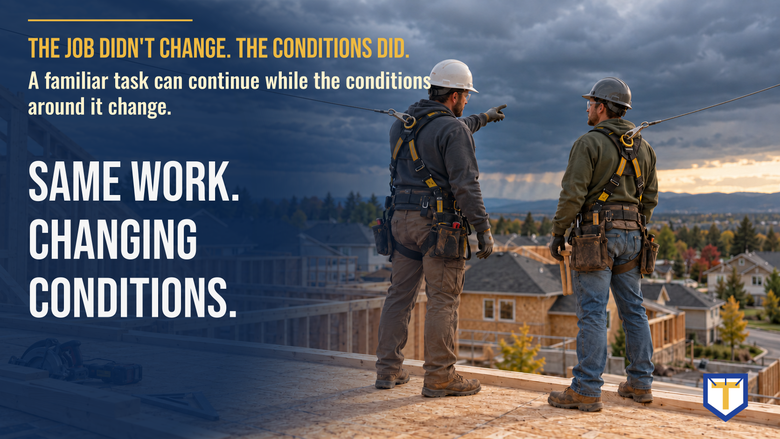
Familiar work can still happen under different conditions
Knowing the work is a good thing. You know the sequence. You know what normal looks like. You know where the rough spots usually are.
But knowing the task doesn’t mean the conditions around it have stayed put.
Weather is the obvious example. Wind can build. Heat can climb. A work area can get wetter, busier, tighter, or more crowded as the day goes on. Another trade can move into the same space. Access can shift. Material can pile up where it wasn’t before.
You may still be doing the same work you started with.
That doesn’t mean you’re doing it under the same conditions.
OSHA treats hazard identification as an ongoing process, not something that only happens once at the beginning. Its construction guidance also calls for looking at hazards that can come from changes in site conditions or work practices.
That lines up with the field side of this pretty well: the task doesn’t have to become unfamiliar before it deserves another look.
Small changes are easy to work around
Big changes usually get your attention.
Small ones are easier to absorb.
Say you start a task and everything looks straightforward. Then one thing changes a little, so you work around it. Something else changes later, and you adjust again. None of it seems big enough by itself to stop and call the job different.
So the work keeps moving.
That’s where you can get caught using the same mental picture you had when the task started, even though the conditions have moved away from it.
You’re not necessarily ignoring something obvious. You may just be doing what people are good at doing: adapting as you go.
The question is whether all those little adjustments have added up to a different situation.
So I’d ask two questions, not one:
“Do we know how to do this task?”
And:
“Are we still doing it under the conditions we planned for?”
Those aren’t the same question.
You don’t have to wait for a new phase
When I talk about a reset point, I’m not talking about starting the whole job over.
You don’t need a new shift, a new phase, or a completely different activity.
The reset can happen right in the middle of ordinary work.
A lot of decisions get made when a task starts: where people will work, how they’ll move through the area, what the conditions look like, and what controls or procedures apply.
Those decisions may have been perfectly sound.
The question is whether the assumptions behind them are still sound now.
That’s the habit I’m after. Don’t wait for the task itself to change before you notice that the situation around the task has changed.
Wind is an easy example
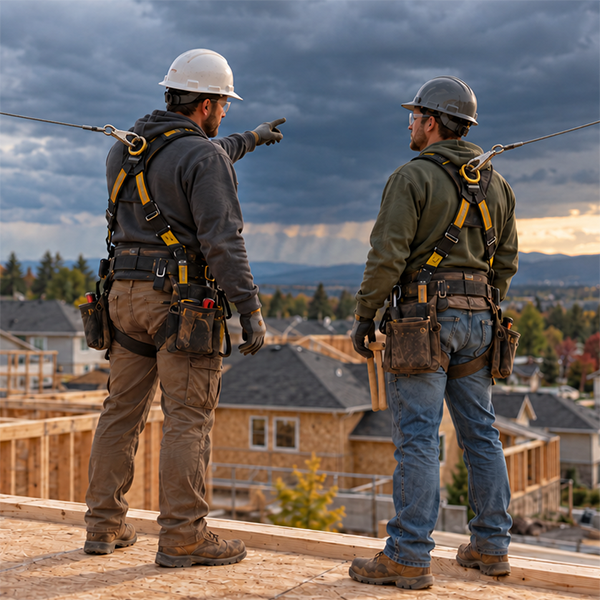
Picture yourself framing, roofing, handling material, or doing another familiar task. The work hasn’t changed, but the wind has been building while you’ve been at it.
That doesn’t automatically tell you what the technical answer is.
It does tell you there’s something worth checking again.
NIOSH identifies high winds as a construction safety concern and emphasizes monitoring weather conditions, especially when work is happening at elevation. I’m not turning that into one wind limit or one stop-work rule for every job. Different work, equipment, sites, and procedures can have different requirements.
The useful part here is the recognition step.
- You may still be doing the same work.
- You may not still be working under the same conditions.
That’s enough to create a new question.
Taking another look doesn’t mean starting over
Reassessment can sound like a bigger deal than it is.
Sometimes it’s simply looking at what changed and asking whether the plan still fits.
Maybe the answer is yes.
Maybe it means checking the job plan, the procedure, the site’s safety direction, the equipment guidance, or whoever is responsible for that decision.
The exact technical answer belongs with the right people and the right authority.
My part comes a little earlier: notice when the question needs to be asked.
“We know this job” can be true and still not tell you everything you need to know about the conditions around it.
Experience should make the change easier to spot
I don’t think familiarity is the problem.
Good experience should help you notice when something isn’t quite the same anymore.
The trouble starts when a familiar task makes it too easy to keep carrying this morning’s assumptions into this afternoon’s conditions.
A useful reset can be pretty simple:
Look at what changed.
Decide whether it matters to the work.
Then use the right person, plan, or procedure to answer the question.
Sometimes the original plan still fits.
Sometimes it doesn’t.
Either way, you’re making that call based on the conditions that actually exist now, not the ones that were there when the task began.
The reset point matters
Jobsites change. Weather changes. Work areas change. People, material, access, and activity move around.
The task may keep the same name through all of it.
That’s why I want you to pay attention to the continuity itself. Sometimes “same job” can hide the fact that the conditions around the job have moved.
Before you simply keep going, ask one practical question:
Are we still working under the same assumptions we started with?
If the answer is no, that’s the reset point.