Safety starts with Safety Pole
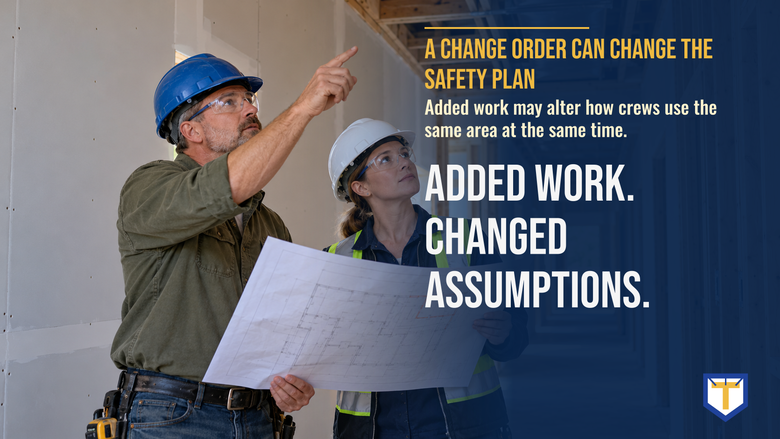
A description of added work can be clear about the finished result and say little about how crews will share the space while doing it. For the project team, the addition has a location and a defined result. For the crews, it also occupies an area, uses access and takes place alongside other work.
Consider one hypothetical revision. The original sequence has overhead installation in a corridor completed before that corridor becomes a regular route for crews working in adjoining rooms. A proposed change adds further overhead work after those adjacent assignments have begun.
The added installation may be easy to describe. What needs another look is the arrangement around it. The corridor was expected to serve one purpose at that point in the sequence. Now your team has to consider another activity in the same space.
In this illustration, the original plan separated the overhead assignment from the corridor’s later use as a route. That sequence was part of the working arrangement, even if it appeared only as two activities on a schedule. It affected when crews expected the area to be available and how they planned to reach their assignments.
The crews in adjoining rooms may have organized material movement around that access. Their supervisors may be expecting the overhead work to be finished. Those expectations would need to be established with the people involved, rather than assumed from the schedule alone.
For your review, the useful baseline is therefore more detailed than “installation complete.” It includes the area occupied by the task, how workers and materials reach it, and when others expect to use the same space. Those details let you compare the change with the arrangement your team was relying on.
OSHA’s hazard-identification recommendations include examining planned operational changes for hazards. Applied to this comparison, the question is which assumptions about the corridor still hold once the added assignment enters the sequence.
Compared with the original sequence, the revision brings the installation crew, its access needs and its material movement back into an area already planned for circulation. The review needs a clear description of those activities before the project team can judge their relationship to the work nearby.
There may be more than one way to organize the revised sequence. The responsible team could examine whether the overhead assignment can be separated from other use of the area, or whether a different arrangement needs evaluation. Choosing a suitable approach requires the actual site conditions and the relevant safety and technical decisions.
The point is to expose the changed relationship, not presume a solution. The addition’s size or commercial value doesn’t establish how much area it occupies while being performed. Nor does a familiar installation task establish that its earlier working arrangements remain suitable now that the corridor has another use.
Follow the effect far enough to understand the adjoining work. If the corridor’s availability changes, which crews depend on it? Do their planned movements still match the revised arrangement? Those are questions about the same scope change, even though those crews aren’t performing the additional installation.
The addition’s size or commercial value doesn’t establish how much area it occupies while being performed.
The supervisor arranging the added installation needs information about the task. The supervisors in the adjoining rooms need to understand any effect on their planned access. A project manager may understand the added scope without having all of that field information. Bring those views together around the corridor’s proposed use.
OSHA’s communication and coordination recommendations address sharing hazard information and coordinating work planning among employers, including when conditions change. Here, that means considering both the crew performing the addition and the crews whose work depends on the same area.
A useful discussion compares the original and proposed arrangements directly: the overhead task previously finished before circulation began; the revised task would occur while adjoining assignments are active. The affected people can then explain the implications for their own work, including an access need that the change description may not reveal.
Where a proposed arrangement still requires technical review, keep that status clear. Repeating an idea through several conversations must not turn it into an apparently settled instruction. The people coordinating the space need the actual determination, including its limits, rather than an interpretation supplied to keep the discussion moving.
Once the relevant decisions are made, explain how the corridor will be used under the revised plan. Identify the affected activity and sequence, the arrangements established for it, and any condition still awaiting resolution. Point to controlling technical information where those details belong.
The old plan may remain valid for much of the project. Make the changed part recognizable so that crews don’t carry an obsolete assumption into this area or mistakenly discard arrangements that still apply elsewhere. The comparison should explain the extent of the revision, as well as its existence.
As the work takes shape, check whether the actual use of the area matches what was reviewed. OSHA’s hazard-prevention and control recommendations include checking continued effectiveness as conditions change. A further alteration to the task or surrounding activity may require another comparison.
The commercial change document remains part of the project’s contractual process, governed by the applicable documents and responsible advisers. The field review has its own practical job: carrying the revised scope into an arrangement the affected crews can understand and use.
In the corridor illustration, the critical difference was the timing of two uses of one space. Your next change may affect a different relationship. Look at what the original sequence made possible, then examine what the addition changes for the people working there. That gives the revised scope a concrete connection to the safety plan.
Other JS Editions
Business risk is not only about what happens after an incident. It also includes the physical controls, planning, documentation, and operating decisions made beforehand. See where fall protection fits into that larger conversation; and why managing the exposure starts with the work itself.