DEDICATED TO GETTING WORKERS HOME SAFELY SINCE 2004

Engineered Fall Protection for Real-World Jobsites

Equip Your Team with Confidence

For questions, concerns, or guidance on the Safety Pole system or fall-safety implementation, contact us.

© 2004–2026 Safety Pole, Inc.

The

JOBSITE STANDARD

Built on Safety. Set as Standard. The Safety Pole Perspective

Safety Systems

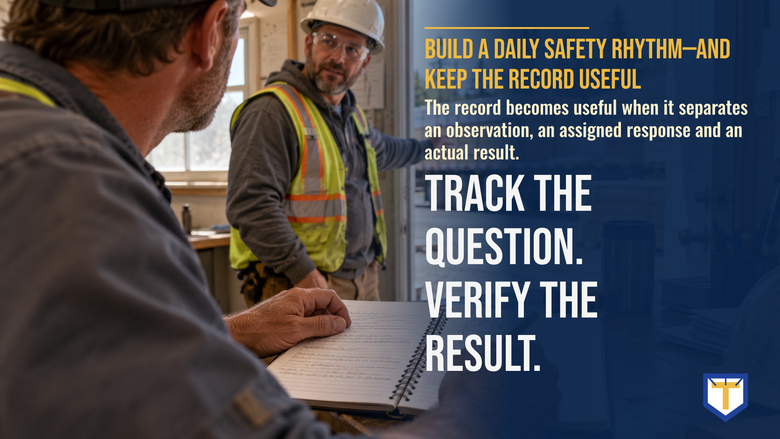
Build a Daily Safety Rhythm—and Keep the Record Useful

The record becomes useful when it separates an observation, an assigned response and an actual result.

By SP Staff Author

Published in J.S. Safety Insights, Jobsite Standard

Build a Daily Safety Rhythm—and Keep the Record Useful

Imagine a morning work discussion in which a foreman raises a practical question: an afternoon delivery may occupy the route the crew expects to use between two work areas. The route is clear now. The concern is what will happen when the material arrives.

This is an illustrative planning situation, not a reported jobsite event. The foreman has noticed a possible conflict. Someone still needs to establish the delivery arrangement, evaluate its effect on access, and communicate what will apply.

A useful daily rhythm connects what you discuss with what people do next. It also preserves the difference between a concern raised, a response requested, and a result confirmed. Without that distinction, the next supervisor may inherit a completion mark while the original question remains unanswered.

Source: S.P. Graphics

Start With What Is Known

In the morning discussion, the foreman can describe the route the crew expects to use and the delivery expected later. The unloading location has not been confirmed. That last point belongs in the account: the concern is a possible conflict, not a verified obstruction or a finding that the delivery plan is unsuitable.

The superintendent identifies the person who coordinates deliveries under this project’s arrangements and asks for the proposed unloading location to be checked against the crew’s access needs. The record now has an observation and an assigned follow-up. It should not yet say that access has been resolved.

A practical planning note should help another person recognize the issue without reconstructing the entire conversation. Here, that means identifying the route, the expected delivery, the open location question, and who is following up. Those details can live in the team’s existing process; the example does not require another form alongside it.

OSHA’s recommended safety-program practices emphasize worker participation in identifying concerns and following up on them. The morning conversation is one opportunity to do that. The daily rhythm described here is a practical suggestion, not a prescribed meeting frequency or a substitute for required training and inspection processes.

Let New Information Change the Note

Later, the delivery coordinator learns that the proposed unloading location would occupy part of the route. Within this illustration, that information changes the question from whether a conflict exists in the proposal to how the affected work and delivery should be arranged. The coordinator brings the detail back to the responsible project personnel rather than treating the initial request as finished.

The note should carry the new information without erasing the earlier uncertainty. It can show that the proposed location is now known and that its effect on the planned route still needs evaluation. That gives the next person a clear account of why further attention is needed.

Notice what has not happened. Finding the proposed unloading location does not establish an appropriate alternative or authorize a change to the work. Those decisions remain with the people responsible under the project’s procedures. The record’s job is to keep their question accurate while they resolve it.

This is where an ordinary note earns its place. A broad entry such as “delivery discussed” would hide the relationship between the material and the crew’s route. A specific entry lets someone understand which arrangement needs attention and where the answer is expected to come from.

A specific entry lets someone understand which arrangement needs attention and where the answer is expected to come from.

Follow the Response Back to the Work

Continue the illustration with the project team reviewing a revised unloading arrangement. The responsible people communicate the agreed location and its implications to the affected crew and delivery personnel. An action has now been assigned and an arrangement communicated. Whether it happens as intended is the next question.

OSHA’s hazard-control guidance includes tracking implementation and checking continued effectiveness as conditions change. For this delivery question, follow-up means establishing what actually happened to the arrangement that was reviewed. A message sent or a revised location written into the plan is not evidence that the material arrived there.

In one possible outcome of this illustration, the delivery is completed and the responsible person checks the reported result: the material is at the reviewed location, and the route at issue remains available at the time of that check. The note can record that specific outcome. It has a clearer meaning than a bare “done,” and it avoids implying that one observation certifies every aspect of the work area.

In the alternative, the delivery has not occurred and the outcome remains unverified. Keep the item open for the person who will follow it through. A delayed truck should not turn a proposed arrangement into a recorded result simply because the supervisor’s shift is ending.

Leave the Next Person a Usable Starting Point

At handoff, return to the same delivery and route question. If the result has been confirmed, explain what was checked and what that finding covers. If the truck is still expected, pass on the agreed arrangement, the outstanding check, and the responsible contact. The next supervisor should not have to discover whether “handled” means requested, arranged, or completed.

OSHA’s hazard-identification guidance recommends documenting inspections so corrections can later be verified. The useful connection for ordinary planning notes is the link between the issue and its follow-up. Such notes remain separate from required inspection records, training documentation, injury and illness records, and other records governed by their own requirements. No particular format or retention interval follows from this example.

Keep the same accuracy when recording acknowledgments. A signature can show acknowledgment within a process; it does not independently establish comprehension or verify a condition. The people responsible still need to attend to the actual work.

By the next planning conversation, the delivery question has a traceable history: what the foreman raised, what new information arrived, what the responsible people arranged, and what was confirmed or left open. Keep enough of that history for the next person to act on the current position. The record is useful because the conversation can continue without turning yesterday’s unanswered question into today’s assumption.

The Jobsite Standard

Autumn Quarter 2026

Safety Systems

Build a Daily Safety Rhythm—and Keep the Record Useful

October 29, 2026

By SP Staff Author

Contents of This Issue

Published Articles

Upcoming Articles

  • A Change Order Can Change the Safety Plan | Scheduled for November 3, 2026
  • The Question Behind a Delayed Fall-Protection Decision | Scheduled for November 10, 2026
  • Evaluating the Safety Pole System for Residential Framing | Scheduled for November 17, 2026

Business Risk Starts With the Work

Business risk is not only about what happens after an incident. It also includes the physical controls, planning, documentation, and operating decisions made beforehand. See where fall protection fits into that larger conversation; and why managing the exposure starts with the work itself.

If you found this article useful, you may wish to receive future issues of The Jobsite Standard. Our email edition shares selected articles, field insights, and updates on safety practices relevant to working at height.

Let's Talk About Your Jobsite

Every project presents unique challenges.

Whether you're evaluating fall protection options, planning an upcoming project, or looking for guidance on creating a safer work environment, our team is here to help.

Send us a message and a Safety Pole representative will contact you to discuss your questions and project needs.

Name
Tell us about your project, safety concerns, fall protection requirements, or any questions you have for our team.

Your information will only be used to respond to your inquiry. We do not sell or share your information with third parties.

Dedicated to Getting Workers Home Safely