A Good Outcome Does Not End the Review
When a worker goes home after an incident, everyone is grateful.
That outcome matters.
The recent Connecticut rescue serves as a reminder that a successful emergency response is something worth recognizing. Trained responders did their jobs. A worker received assistance. A situation that could have become significantly worse ended with a far better outcome than many fall incidents produce.
For project teams, however, the conclusion of the emergency is often the beginning of a different process.
- The worker has been transported.
- The rescue operation has concluded.
- The site has stabilized.
Now the review begins.
Experienced construction professionals understand this transition well.
If you’ve ever been responsible for managing the aftermath of an incident, you know how quickly the focus shifts from the event itself to the information surrounding it.
- What happened?
- Who was involved?
- What protections were in place?
- What documentation exists?
- What can be verified?
In the hours and days that follow, project teams often find themselves gathering information from multiple sources.
- Training documentation.
- Inspection records.
- Site-specific safety plans.
- Equipment certifications.
- Photographs.
- Daily reports.
- Toolbox talk records.
- Competent person designations.
- Witness statements.
What may have felt routine before the incident can suddenly become critically important afterward.
A weekly inspection log that took only a few minutes to complete may become one of the most important documents on the project.
A training session conducted months earlier may become evidence that workers received instruction on the systems being used.
A competent person designation that seemed largely administrative at the beginning of the project may become a key element in demonstrating how fall protection responsibilities were assigned and managed.
These details matter because every organization involved is attempting to answer the same fundamental question:
- Did the systems perform as intended?
- For contractors, that review often begins internally.
- Safety managers evaluate procedures.
- Superintendents review field conditions.
Operations leaders assess whether expectations were clearly communicated and consistently followed.
Depending on the circumstances, additional parties may also conduct their own evaluations.
- General contractors may review project records.
- Insurance carriers may request documentation.
- Risk consultants may assess procedures and controls.
- Regulatory agencies may examine whether applicable requirements were satisfied.
None of these reviews automatically imply wrongdoing.
Nor do they necessarily indicate that an incident resulted from negligence or noncompliance.
Their purpose is to understand what occurred and determine whether existing systems were effective.
This reality is one reason many construction firms have moved beyond viewing fall protection solely as equipment selection.
Increasingly, fall protection is being evaluated as a managed process that includes planning, training, inspection, documentation, supervision, communication, and rescue preparedness.
The question is no longer simply:
“Did we have fall protection available?”
The question becomes:
“Can we demonstrate how fall risks were identified, addressed, communicated, monitored, and managed throughout the life of the project?”
For company owners and operational leaders, that distinction carries significant implications.
The quality of a safety program is often measured long before an incident occurs.
Its effectiveness, however, is frequently evaluated afterward.
In many respects, the review process becomes a test of preparation.
Not simply whether protection existed.
- But whether responsibilities were understood.
- Whether procedures were followed.
- Whether records were maintained.
- Whether planning translated into execution.
The strongest safety programs are rarely judged solely by what happens during normal operations.
They are often judged by how clearly their preparation can be seen after something unexpected occurs.
And that preparation is often far easier to demonstrate when systems, responsibilities, inspections, and procedures have been established long before they are needed.

What Insurers, Auditors, and Clients See
By the time the Connecticut rescue concluded, the immediate emergency was over.
- The worker had been safely removed.
- Emergency responders had completed their work.
- The project team could finally begin taking stock of what had happened.
- For many crews, that is the point where the incident begins to feel like it is behind them.
For ownership, insurers, auditors, clients, and project stakeholders, however, a different evaluation is often just beginning.
The focus gradually shifts away from the emergency itself and toward the broader business implications surrounding it.
If you’ve ever been involved in the weeks that follow a serious incident, you know how the conversations begin to change.
- How was the work planned?
- What protections were in place?
- Who verified them?
- What documentation exists?
- What can be demonstrated?
What can be improved before the next project begins?
Those questions matter because a fall incident is rarely evaluated as an isolated event. It is often viewed as a window into how an organization manages risk across its entire operation.
From an insurance perspective, one of the most recognized measurements is Experience Modification Rate, or EMR.
Most contractors are familiar with the number, particularly when bidding work or completing prequalification packages. What is sometimes overlooked is that EMR is not simply an insurance statistic. It is often viewed as a reflection of a company’s overall risk profile.
If you’ve ever submitted qualifications for a project, there’s a good chance someone asked for your EMR before they asked about your equipment fleet, project portfolio, or production capabilities.
EMR is only one piece of the picture.
Many project owners and general contractors also review safety performance indicators such as Total Recordable Incident Rate (TRIR), DART Rate (Days Away, Restricted, or Transferred), lost-time incident history, OSHA citation history, and the maturity of a contractor’s safety management program.
These metrics are not designed to punish contractors.
They exist because owners, insurers, and risk managers are attempting to answer a practical business question:
How likely is this contractor to successfully manage risk on future projects?
For many construction firms, that question extends beyond safety performance alone. It reaches into profitability, scheduling, resource planning, and long-term growth.
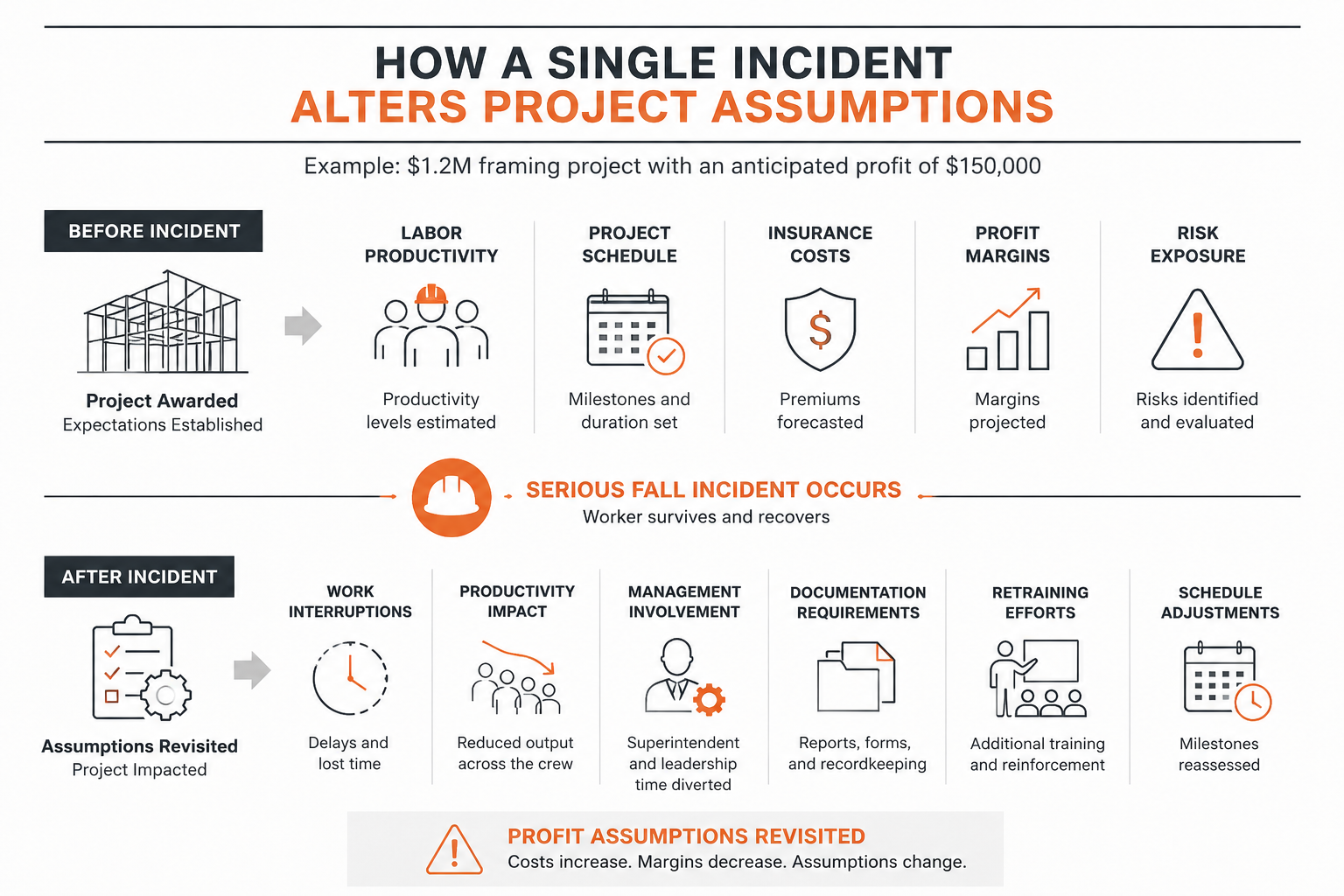
Most projects begin with assumptions.
- Labor productivity is estimated.
- Schedules are established.
- Insurance costs are forecast.
- Profit margins are projected.
- Risk exposure is evaluated.
A significant incident can force many of those assumptions to be revisited.
Consider a hypothetical framing contractor awarded a $1.2 million project with an anticipated profit of $150,000. Midway through construction, a serious fall incident occurs. The worker survives and ultimately recovers, but the project experiences work interruptions, additional safety meetings, documentation requirements, retraining efforts, management involvement, and schedule adjustments.
Individually, each of those disruptions may appear manageable.
Collectively, they begin changing the financial assumptions upon which the project was originally estimated.
A project expected to deliver a healthy return can see that margin steadily reduced—not because of a single catastrophic expense, but because dozens of smaller operational costs accumulate throughout the remainder of the job.
In that sense, the financial impact of an incident is not always measured solely by medical costs or insurance claims.
It is often measured through the disruption of assumptions that existed before the incident occurred.
Insurance considerations create another layer of evaluation.
Suppose a contractor currently maintains an EMR of 0.90 and pays approximately $100,000 annually in workers’ compensation premiums. Following a significant claim, that EMR increases to 1.15 over subsequent rating periods.
At first glance, the difference may appear modest.
Over several years, however, the resulting premium increases could represent tens of thousands of dollars in additional operating expense.
The incident itself may be resolved.
The financial effects may continue long afterward.
Many project owners and general contractors evaluate similar concerns when reviewing contractors for future work.
On larger commercial, industrial, and institutional projects, safety metrics such as EMR, TRIR, DART rates, OSHA history, and overall safety performance are frequently reviewed during contractor prequalification.
In some cases, those evaluations occur before pricing proposals are ever considered.
A contractor may possess the equipment, personnel, and expertise necessary to perform the work successfully.
Yet if safety metrics fall outside project requirements, the opportunity may never advance to the bidding stage.
Viewed from this perspective, an incident can influence more than the project on which it occurred.
It may influence future opportunities as well.
There is also a category of cost that rarely appears on financial statements but is familiar to many construction leaders.
Time.
A superintendent may spend hours gathering records and participating in reviews.
A project manager may devote days responding to documentation requests, coordinating follow-up actions, and revising schedules.
Owners and executives may spend additional time meeting with insurers, clients, legal counsel, and risk consultants.
None of those activities generate revenue.
Yet they consume resources that were originally committed elsewhere.
- The project absorbs that cost.
- The company absorbs that cost.
- Profitability absorbs that cost.
This is why insurers, auditors, clients, and project owners often focus so heavily on systems rather than individual incidents.
During insurance reviews, audits, and contractor prequalification processes, evaluators frequently look for evidence of a systematic approach to fall protection and hazard management. They review training records, competent person designations, inspection documentation, rescue procedures, and site-specific safety plans because those elements provide insight into how risk is managed throughout an organization.
In other words, they are not simply evaluating whether an incident occurred.
They are evaluating whether the organization had a repeatable process designed to prevent it.
- A developer investing millions into a project wants confidence that risk is being managed systematically.
- A general contractor wants confidence that subcontractors can operate safely without creating disruptions to schedule and performance.
- An insurer wants confidence that exposure is being reduced through planning, training, documentation, and operational discipline.
- The strongest safety programs tend to perform well in these reviews because they create consistency.
- Workers know what is expected.
- Supervisors know what must be verified.
Documentation supports field practices.
Procedures remain consistent from project to project.
That consistency matters because incidents are not the only events being evaluated.
The systems behind them are as well.
For construction leaders, this may be one of the most overlooked aspects of fall prevention.
- A fall incident may begin as a safety event.
- It often becomes a business event.
- A safety program protects workers first.
At the same time, it protects project assumptions, supports contractor qualifications, strengthens client confidence, influences insurance outcomes, preserves future opportunities, and demonstrates the operational maturity of the organization itself.
Long after the immediate details of an incident have faded, those factors may continue shaping costs, opportunities, and business relationships for years to come.
The Conversation Before the Incident
The recent Connecticut rescue ended with a worker being brought safely to the ground and transported for medical care.
That outcome is something everyone in the construction industry can appreciate.
Emergency responders did their jobs. The worker survived. What could have become a far more serious situation ended with trained professionals successfully carrying out a difficult rescue operation.
At the same time, incidents like these serve as reminders that fall protection is about far more than responding effectively when something goes wrong.
For safety managers, superintendents, and company owners, the most important lessons often emerge long before emergency responders arrive on site.
Ask enough experienced superintendents about the most challenging days of their careers and many will describe incidents that interrupted work, redirected attention, and changed the course of a project in an instant.
Very few will tell you those days began with an emergency.
Most began as ordinary workdays.
- The crews arrived.
- The work plan was discussed.
- Materials were staged.
- Tasks were assigned.
- Production began.
Then something unexpected happened.
That reality is why effective fall protection starts long before workers access elevated work areas.
The most important questions are rarely asked during an emergency.
They are asked during planning meetings.
- How will workers be protected?
- Who is responsible for verifying the system?
- How will new workers be trained?
- What documentation will be maintained?
- What happens if a rescue becomes necessary?
- Can the process be repeated consistently from one project to the next?
These questions may seem routine at the beginning of a project. Yet they often become the foundation upon which every later decision rests.
The strongest projects are rarely remembered because crews successfully responded to emergencies.
They are remembered because thoughtful planning prevented many emergencies from occurring in the first place.
The same principle applies to fall protection.
When protection is designed into a project from the beginning, crews spend less time improvising. Supervisors spend less time managing uncertainty. Documentation becomes easier to maintain. Accountability becomes clearer. Protection becomes part of the workflow rather than a reaction to changing conditions.
Across the construction industry, this shift is becoming increasingly visible.
Contractors are moving beyond viewing fall protection as a collection of equipment and toward treating it as part of overall project infrastructure. The conversation is expanding beyond compliance alone to include planning, consistency, documentation, rescue preparedness, operational efficiency, insurance performance, and long-term risk management.
Engineered systems such as Safety Pole represent one example of this broader evolution. Rather than relying on improvised solutions or protection that must constantly adapt to changing conditions, these approaches seek to establish fall protection as a planned component of project execution from the outset.
The recent Connecticut rescue is ultimately a positive story because trained professionals responded effectively and a worker survived.
For the rest of the industry, however, it also provides a valuable reminder.
The conversations that matter most after a fall incident are often the conversations that occurred before the incident ever took place.
- Planning.
- Training.
- Documentation.
- Rescue preparedness.
- Engineered systems.
- Clear accountability.
These are the elements that influence outcomes long before anyone makes a 911 call.
The goal is not simply to respond effectively when conditions change unexpectedly.
The goal is to build projects where protection, preparation, and risk management are integrated into the work from the very beginning.