Posted on

Component Weights

Component Weights for the Safety Pole System

The Weight of the Components for the Safety Pole System chart provides a detailed breakdown of the individual parts that comprise a standard two-pole configuration, along with their respective weights and quantities. This information is useful for understanding how the system’s total mass is distributed across its major structural and functional components.

The combined weight of the two-pole system is 1,044.5 lbs, with the largest contribution coming from the 10-foot pole sections, which together account for 566 lbs of the total. The 5-foot sections represent the next most significant portion at 168 lbs, reflecting their role in providing modular height adjustment while maintaining structural continuity. Additional components—including base sections, tee sections, shoes, pullers, the horizontal lifeline (HLL), and cables—contribute smaller but essential portions of the overall weight.

As illustrated in the chart, weight is distributed across multiple components rather than concentrated in a single element. This distribution supports system stability while preserving modularity for transport, staging, and installation. Understanding the relative weight of each component can assist installers and site supervisors in planning material handling, sequencing setup activities, and assessing logistical requirements, while also providing general reference context for system configuration and use.

Posted on

The Benefits of Overhead Fall Protection in Construction

Overhead fall protection systems have become increasingly popular in the building industry in recent years, and for good reason. Falls are one of the leading causes of workplace injuries and fatalities, and the construction industry has some of the highest rates of these incidents. According to the Occupational Safety and Health Administration (OSHA), falls from heights are the leading cause of death in the construction industry. And in 2024, Fall Protection violations topped OSHA’s list again for most commonly cited by a margin of nearly 2:1 over the second ranking violation.  In this article, we will explore the benefits of overhead fall protection systems and why they are essential for workplace safety.

  1. Increased safety

The primary benefit of overhead fall protection systems is the increased safety they provide to workers. These systems are designed to prevent falls from heights and can significantly reduce the risk of injury or death in the workplace. According to OSHA, falls can be prevented by using appropriate fall protection equipment, such as guardrails, safety nets, and personal fall arrest systems.

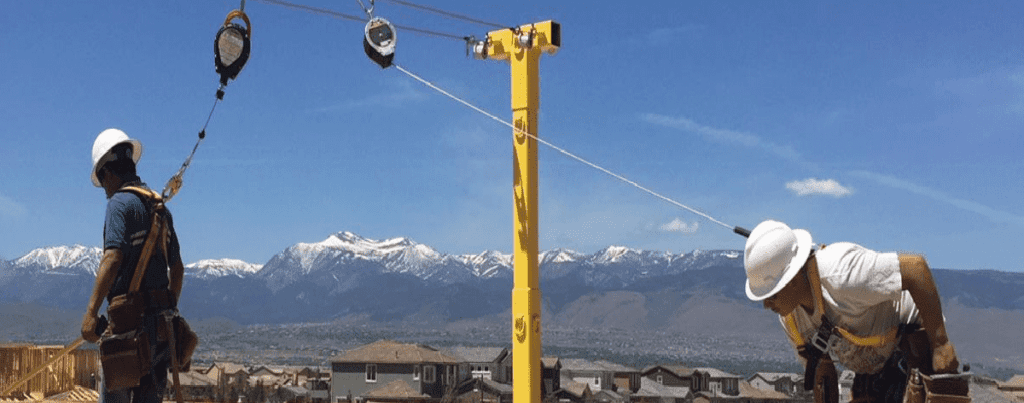
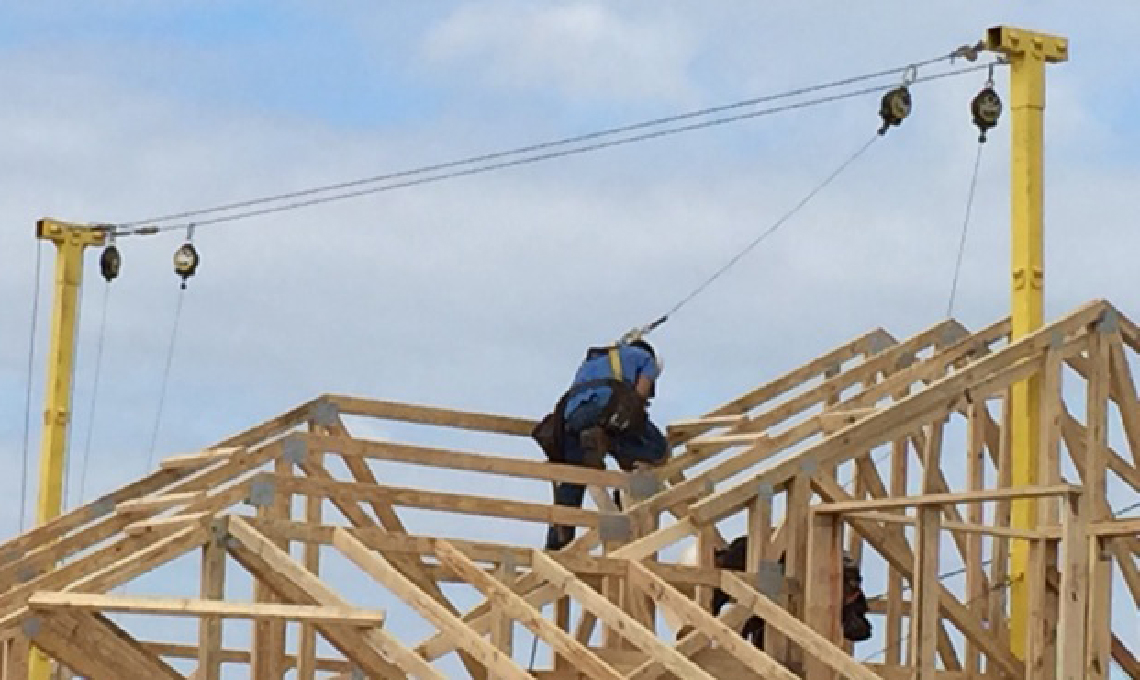
Overhead fall protection systems, such as horizontal lifelines and anchor points, can be customized to meet the specific needs of each job site. They provide workers with a secure anchorage point that they can attach to when working at heights, allowing them to move around freely while being protected from falls. This increased safety not only benefits workers but also helps to reduce the financial and legal risks that companies face when employees are injured on the job.

  • 2. Compliance with safety regulations

Another benefit of overhead fall protection systems is that they help companies comply with safety regulations. OSHA requires employers to provide fall protection to workers who are working at heights of six feet or more. Failure to comply with these regulations can result in fines and legal liabilities.  In 2022, OSHA dealt out over $31 million in fines to construction companies due to violations of fall protection policies.

By implementing overhead fall protection systems, companies can ensure that they are meeting safety requirements and reducing the risk of accidents and injuries in the workplace. This can also help to improve the company’s reputation among clients and employees, as a commitment to safety is seen as a sign of responsibility and professionalism.

3.Increased productivity

While safety is the primary concern of overhead fall protection systems, they can also provide additional benefits to companies, such as increased productivity. When workers feel safe and secure in their work environment, they are more likely to be productive and focused on their tasks. By reducing the risk of falls and injuries, companies can create a work environment that is conducive to productivity and success.

4.  Cost-effective

Overhead fall protection systems can also be cost-effective for companies in the long run. While the initial investment may be high, the cost of accidents and injuries can be much higher. According to OSHA, the average cost of a fall-related injury in the construction industry is over $100,000. This includes medical expenses, lost wages, and legal fees.

By implementing overhead fall protection systems, companies can reduce the risk of these costs and potentially save money in the long run. Additionally, the implementation of these systems can help to improve the company’s reputation and attract new clients who prioritize safety and responsible business practices.

5. Flexibility

Overhead fall protection systems are flexible and can be customized to meet the specific needs of each job site. These systems can be used in a variety of applications, such as roofing, scaffolding, and bridge construction. They can also be adapted to fit different work environments, including indoor and outdoor spaces.

6.  Employee morale

Finally, overhead fall protection systems can have a positive impact on employee morale. When workers feel safe and protected in their work environment, they are more likely to feel valued and respected by their employers. This can lead to increased job satisfaction and loyalty to the company.

Conclusion

Overall, overhead fall protection systems are essential for workplace safety in the building industry. They provide increased safety, help companies comply with safety regulations, increase productivity, and can be cost-effective in the long run. Additionally, these systems are flexible and can be customized to meet the specific needs of each job site.

There are still more benefits to employing an overhead fall protection system.  Check out our previous blog posts to find out what they are.

Then contact Safety Pole to make your work sites safer.

Posted on

The Jury Is In. The Legal Cost of a Fall on the Job

The jury is in

The jury is in

Construction work is dangerous.  More injuries occur in the construction trade than any other profession.  And the most common injury to occur on a construction jobsite are falls.

OSHA Fines

If there is inadequate or no fall protection in place and a worker is severely injured in a fall, OSHA will fine the contractor $156,259 per finding.  Bump that up to $500,000 if the fall results in death.

And that’s just OSHA fines.  If the fallen worker’s family sues the contractor (most likely), the monetary damages will be several times more.  If there were no controls in place, it would constitute “gross criminal negligence” resulting in a first degree manslaughter conviction which would send the responsible party to prison for 10-15 years.

If there was some fall protection in place that OSHA finds inadequate, the fines are same as if there was no protection at all.  The good news is the criminal liability for the responsible party is less.  Only 2.5-5 years for negligent homicide.

According to the U.S. Department of Labor Statistics, in 2021 there were 393 falls on construction sites resulting in death.  Doing the math, that results in over $196 million in just OSHA fines alone. 

Mitigating Risk

Serious injuries and death resulting from a fall on a jobsite is tragic.  The resulting fines can bankrupt companies that result in lost jobs and income is regrettable.

And avoidable.

Utilizing an overhead fall protection system like the Safety Pole can mitigate the injuries, deaths, fines and bankruptcies.

Still, many framing contractors say that such systems are too expensive.  Wrong!  They’re essentially free.

Financial Incentives for Fall Protection

Section 179 of the Tax Cuts and Jobs Act of 2018 allows businesses to deduct up to $1,160,000 of capital expenditures like the Safety Pole just this year alone.

Many states offer grants that can be applied to the purchase of safety equipment, including the Safety Pole.

Workers Compensation insurance premiums are a major expense for many framing contractors.  However, one Safety Pole customer, JL Schwieters in Hugo, MN, was able to lower their Mod Rate by 30%.  So much so that they are now self insured. 

If you are a framing contractor there is simply no rational reason not to employ an overhead fall protection system like Safety Pole for their workers.  Save money, avoid fines and save lives.  Contact Safety Pole today before it’s too late.

OSHA Fines

Posted on

Break Out The Welcome Mat – OSHA is Stopping By

OSHA welcome mat

An article published by The National Law Review reports that in May, the U.S. Department of Labor announced the launch of a new Occupational Safety and Health Administration (OSHA) initiative aimed at addressing one of the most persistent hazards in the workplace: falls. Specifically, OSHA has introduced a National Emphasis Program (NEP) focused on preventing and reducing fall-related injuries and fatalities, with particular attention directed toward the construction industry.

As part of the program’s rollout, OSHA established a mandatory 90-day outreach and education period. During this time, the agency is informing employers and workers about the program’s scope, expectations, and enforcement priorities. As a result, formal site inspections under the NEP are scheduled to begin on or about July 30, 2023. While the program does not have a defined end date, OSHA has stated that it will remain in effect for a minimum of six months and may continue beyond that timeframe depending on enforcement findings and ongoing risk levels.

Although the NEP applies to several industries where fall hazards are present, OSHA has made it clear that construction will be a primary focus. This emphasis is supported by injury and fatality data. In 2021, workplace falls accounted for 5,190 fatalities across all industries in the United States. Of those, 986 occurred within the construction sector, underscoring the disproportionate risk faced by construction workers and the ongoing need for focused prevention efforts.

In announcing the program, OSHA explained its rationale by noting that falls remain the leading cause of death and serious injury across multiple industries. Given this persistent trend, the agency determined that an increase in both enforcement activity and outreach efforts was warranted. The Fall NEP is intended not only to identify noncompliance, but also to reinforce the importance of systematic fall protection planning and implementation.

One of the key aspects of the NEP is the nature of inspections themselves. Inspections may occur without advance notice. An OSHA compliance officer does not need a formal complaint or scheduled visit to initiate an inspection. If an officer observes employees working at height while driving past a jobsite or traveling for unrelated reasons, they are authorized to stop and conduct an on-the-spot inspection. This approach reflects OSHA’s intent to address fall hazards as they are encountered in real-world conditions, rather than only during prearranged visits.

If, during an inspection, a compliance officer identifies inadequate fall protection—or the absence of fall protection altogether—the consequences can be significant. OSHA citations for fall protection violations are often classified as serious and can carry substantial monetary penalties. In addition to fines, deficiencies may result in work stoppages, corrective action requirements, and increased regulatory scrutiny. In more severe cases, particularly where willful violations or fatalities are involved, certain offenses can expose employers to criminal liability. These outcomes can have lasting operational and financial impacts.

For construction framing contractors and others operating in high-risk environments, the implementation timeline still allows an opportunity to evaluate current practices and make necessary improvements. However, with inspections beginning at the end of July, that window is narrowing. Ensuring that appropriate fall protection systems are properly planned, installed, and maintained before enforcement activity increases is a practical step toward risk reduction and regulatory readiness.

Contractors who have not yet reviewed their fall protection approach may wish to do so promptly. Establishing compliant systems in advance of enforcement activity can help reduce uncertainty during inspections and support safer working conditions on site.

Posted on

ICG Wins National Award For Using The Safety Pole

The National Framers Council recently hosted a photo contest to support OSHA’s 2021 National Safety Stand Down initiative.  This was the 8th annual national event aimed at stopping preventable construction fall-related fatalities across the country.  Building framers were encouraged to participate in safety-focused activities and send in photographic proof of their practices.

Safety Pole’s long-time customer, Innovative Construction Group in Florida was announced the winner for their use of the Safety Pole’s fall-arrest system while installing their roof trusses.  As they stated on their website, “Taking less than an hour, with a two-worker crew, to set up; the fall arrest system, is extremely durable, and satisfies OSHA fall protection requirements for residential construction. Providing fall arrest protection for workers during all phases of framing including the installation of exterior walls, setting roof trusses, sheathing the roof, or installing fascia, the Safety Pole System is an investment ICG is proud to have made.

What is a Safety Stand Down?  

A Safety Stand-Down is a voluntary event for employers to talk directly to employees about safety. Any workplace can hold a stand-down by taking a break to focus on “Fall Hazards” and reinforcing the importance of “Fall Prevention”. Employers of companies not exposed to fall hazards, can also use this opportunity to have a conversation with employees about the other job hazards they face, protective methods, and the company’s safety policies and goals. It can also be an opportunity for employees to talk to management about fall and other job hazards they see.

Safety Pole congratulates ICG for winning this prestigious award.  We are proud to have been a part of it!

Posted on

Safety Pole Saves Worker At Innovative Construction Group

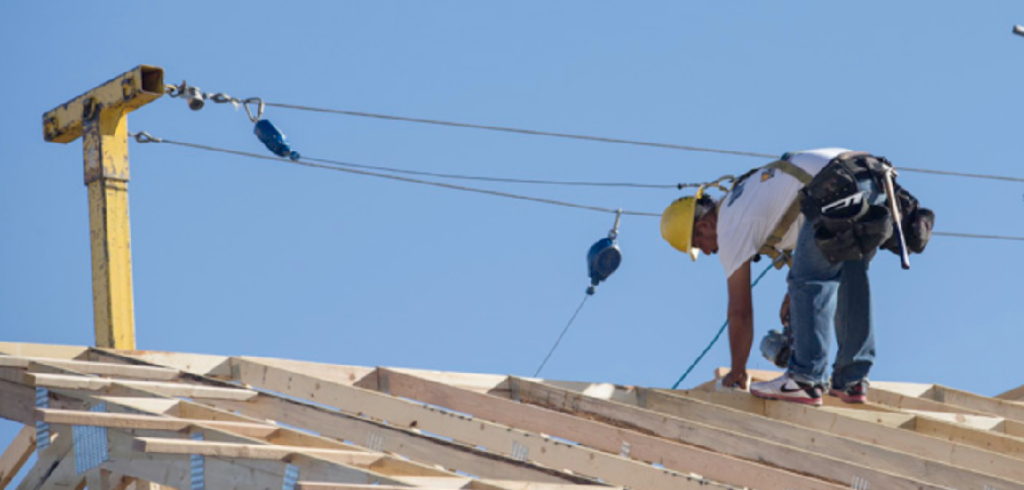
On July 31, 2023 a worker at Innovative Construction Group fell off a roof at a jobsite.  Fortunately, his fall was stopped due to his fall arrest harness that was attached to the Safety Pole.

The worker was tied off to the Safety Pole utilizing the D-Ring as the anchor point.  He was utilizing a rope with a rope grab as his lifeline connected to the D-Ring on his harness.  

The worker was working near the edge of the roof when he lost balance and fell backwards off the roof.  The SRL that was attached to the Safety Pole stopped his fall just three feet from the ground.  He was able to pull himself up, unhook his harness and dropped the rest of the way.

The worker displayed no sign of injury and no medical attention was needed.

Due to the nature of the fall conventional scaffolding would most likely not have stopped the worker from suffering significant injuries or even death.  Only the design and construction of the Safety Pole averted what otherwise would have been a disastrous outcome.

Innovative Construction Group prides itself in promoting a culture of safety.  And they are no strangers on the topic.  In 2021 ICG won a national award for using The Safety Pole.  They submitted a photo featuring The Safety Pole to the National Framers Council photo contest to support OSHA’s 2021 National Safety Stand Down initiative. 

ICG has been using The Safety Pole for over ten years.  They, and other Safety Pole customers, gladly make the investment to ensure their workers get home safely each night and back on the job tomorrow.

To learn more about the many benefits the Safety Pole provides, see our other blog post “How Much Does the Safety Pole Cost?“.

Posted on

Value of the Safety Pole

As a framing contractor, providing a safe workplace is always a good investment.  Between tax deductions, lower workers comp insurance premiums, reduction of OSHA fines and even state grants, utilizing the Safety Pole fall arrest system on your job sites will essentially cover the entire cost.

The Grim Statistics

According to the Bureau of Labor in 2019 there were more than 14,000 falls to a lower level in the construction industry.  Of these, more than 400 resulted in death.  Those workers who did not die however lost an average of 28 work days recovering from their fall.

That’s a lot of lost productivity and hefty workers comp claims!

Mitigating The Cost Factors of Fall Protection

Tax Incentives

Section 179 of the Tax Cuts and Jobs Act was enacted in 2018 and made significant changes in the way that companies can write off capital expenditures. In the past, it was necessary to depreciate the cost of an asset over a number of years. With the recent change, businesses can now write off the entire cost of the capital expenditure in the year that the purchase was made.

In 2025 a business can claim the deductions of up to $1,160,000.  This can be equipment that you purchase, lease or finance.  But you must put the equipment into service by December 31, 2025.  As of now, this tax cut is scheduled to expire after this year.

Lower Workers Comp Premium

Workers Compensation insurance premiums are directly related to the number of claims submitted.  Like any other type of insurance (auto, home, etc.), the more claims you file the higher your premium. 

The insurance company, Liberty Mutual, releases an annual report ranking the top 10 workplace injuries by their direct costs to businesses in the USA.  Their 2018 report shows over $17 Billion in direct workers compensation costs were due to non-fatal falls on construction sites.

Many builders that employ the Safety Pole fall protection system have seen an almost immediate decrease in their Workers Comp insurance premiums.  This cost reduction has a positive effect on their bottom line and overall profitability of their business.

OSHA

Nothing can ruin a framer’s day faster than seeing OSHA arrive on a job site.  Because of the overwhelming number of fall related injuries, the first place they tend to inspect is for a compliant fall protection system.  If that is not up to snuff, the penalties can amount to thousands of dollars.

For framers that employ the Safety Pole system, it’s been known to happen when an OSHA inspector sees the Safety Pole in use and drives away without even getting out of their car.  Suddenly, that framer’s day is bright and sunny again!

Grants

Many states offer grants to construction companies that purchase workplace safety equipment including fall protection systems like the Safety Pole.  These are grants and do not need to be repaid. 

As an example, the Minnesota Department of Labor and Industry currently offers employers a $10,000 grant for the projects designed to reduce the risk of injuries on the job.  Projects like the Safety Pole.

Indirect Benefits

Better Employee Morale

Numerous studies over the years have proven that employees that feel safe at their place of work are more productive.  They do a better job and they do it faster knowing that they are safe from injury.

Better Productivity

The average amount of lost time to a worker falling on the job is 28 days!  The job still needs to be completed though now with fewer workers.  Typically, the job completion is delayed or the contractor scrambles to replace that worker and train them.  All of this, and more, reduces overall productivity which reduces profitability.

Conclusion

For framing contractors, investing in the Safety Pole is a no-brainer.  The direct financial benefits are numerous.  And the indirect benefits are good for business and its bottom line.

Contact Safety Pole today for your free estimate at no obligation.