

DEDICATED TO GETTING WORKERS HOME SAFELY SINCE 2004

Engineered Fall Protection for Real-World Jobsites

Equip Your Team with Confidence

For questions, concerns, or guidance on the Safety Pole system or fall-safety implementation, contact us.

© 2004–2026 Safety Pole, Inc.

Safety Pole DOcumentation

Component Weights

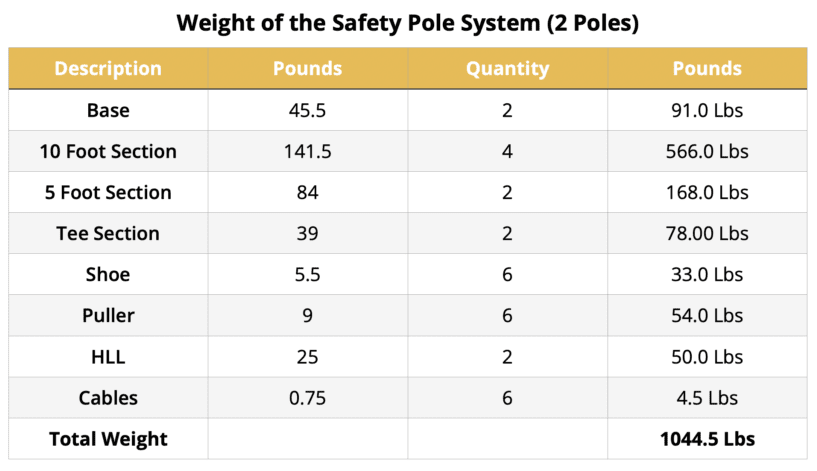
Reference chart of Safety Pole System weights

Document Control

Document Status

Current

Version

v1.0

Effective Date

01/08/2026

Applies To

Document Status

Intended Audience

Installer, Site Supervisor, General Reference

Instructional Sensitivity

Reference Only

Last Reviewed

01/08/2026

Download

Unavailable

The information below serves as a technical reference and should be applied in conjunction with appropriate training, supervision, and site-specific considerations.

This chart provides a reference overview of the individual component weights that make up a two-pole Safety Pole system. It is intended to support installers and site supervisors with planning, handling, and logistics considerations, while also serving as a general technical reference for system evaluation.

Component Weights for the Safety Pole System

The Weight of the Components for the Safety Pole System chart provides a detailed breakdown of the individual parts that comprise a standard two-pole configuration, along with their respective weights and quantities. This information is useful for understanding how the system’s total mass is distributed across its major structural and functional components.

The combined weight of the two-pole system is 1,044.5 lbs, with the largest contribution coming from the 10-foot pole sections, which together account for 566 lbs of the total. The 5-foot sections represent the next most significant portion at 168 lbs, reflecting their role in providing modular height adjustment while maintaining structural continuity. Additional components—including base sections, tee sections, shoes, pullers, the horizontal lifeline (HLL), and cables—contribute smaller but essential portions of the overall weight.

As illustrated in the chart, weight is distributed across multiple components rather than concentrated in a single element. This distribution supports system stability while preserving modularity for transport, staging, and installation. Understanding the relative weight of each component can assist installers and site supervisors in planning material handling, sequencing setup activities, and assessing logistical requirements, while also providing general reference context for system configuration and use.


Document Information

Last Reviewed

01/08/2026

Governing Document

Does Not Apply

Supersedes

Does Not Apply

Publication Date

January 8, 2026

Other Documentation

Related Documentation

Recent Documentation

Documentation Questions & Clarifications

Please Let Us Know if You Need Clarification?

If you have questions or need clarification regarding the documentation on this page, you may contact Safety Pole using the form below.

This channel is intended to support understanding of published documentation and reference materials.

Name
We’ll use this to respond to your question.
Please describe the part of the documentation you are referring to or the clarification you are seeking.
Acknowledgment

Dedicated to Getting Workers Home Safely