


What Sets Safety Pole Systems Apart
Fall protection planned around the way construction actually moves.
The Safety Pole System is a modular construction fall-protection system designed to bring usable anchorage into the work area and make fall protection part of the way elevated work is planned.
That matters because the jobsite does not stay in one place.
Crews move. Working elevations change. Walls go up. Upper floors become active. Trusses, roof framing, sheathing and other elevated operations follow. The fall-protection plan has to account for that progression.
Safety Pole gives contractors a way to plan anchorage around the work; not simply react after the work area changes.
What is the Safety Pole System?
Modular Fall Protection
Safety Pole provides planned anchorage infrastructure for construction fall protection.
The same modular system family can support different applications and deployment approaches, including Single Anchor and Horizontal Lifeline (HLL) use, according to the requirements of the work.
It is not a complete fall-protection program by itself. Training, inspection, supervision, PPE, proper installation and project-specific planning remain essential parts of the contractor’s overall program.
Who is it for?
Safety Pole is designed for construction teams that need a practical way to plan fall-protection anchorage as elevated work changes.
That can bring several people into the same planning conversation:
- contractor owners and managers;
- safety professionals;
- estimators and preconstruction teams;
- superintendents and field leaders; and
- crews responsible for performing the work.
Each may look at fall protection from a different perspective, but all of them ultimately have to answer the same question:
How will usable fall protection be available where the work is actually taking place?
Where does Safety Pole fit?
Safety Pole fits within the contractor’s larger fall-protection and project-planning process.
Rather than treating anchorage as an isolated piece of equipment, the system can be considered alongside:
- the construction sequence;
- changing working elevations;
- crew movement;
- access to the work;
- planned fall-protection methods; and
- the operational requirements of the project.
Where project conditions and approved planning allow, Safety Pole may also reduce or replace certain framing-phase scaffold applications. Those opportunities are project-specific and should be evaluated against the actual work.

When should Safety Pole enter the conversation?
Ideally, before elevated exposure begins.
When fall protection is considered during estimating, preconstruction and sequencing, the project team has an opportunity to decide where anchorage will be needed, how the system will be deployed and how protection will progress as the work changes.
That turns fall protection from a last-minute equipment question into part of the work plan.
Examine the Business Value Behind Your Safety Program
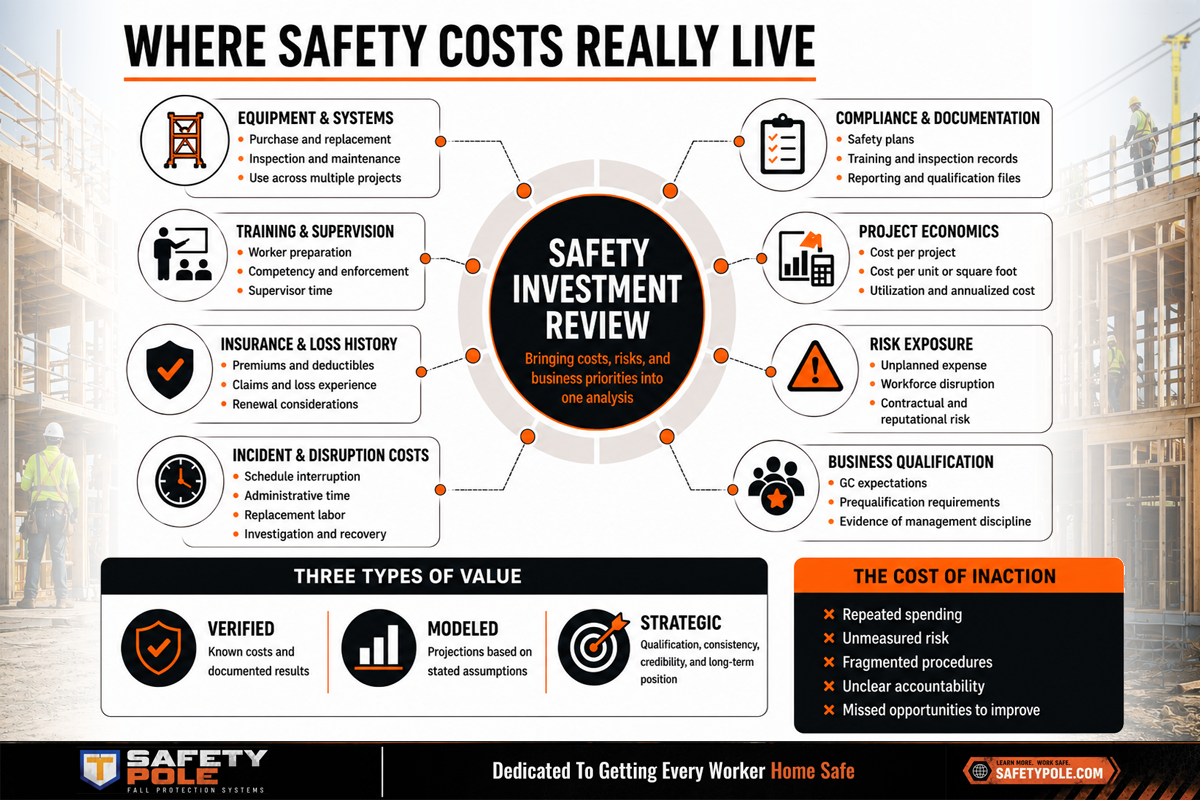
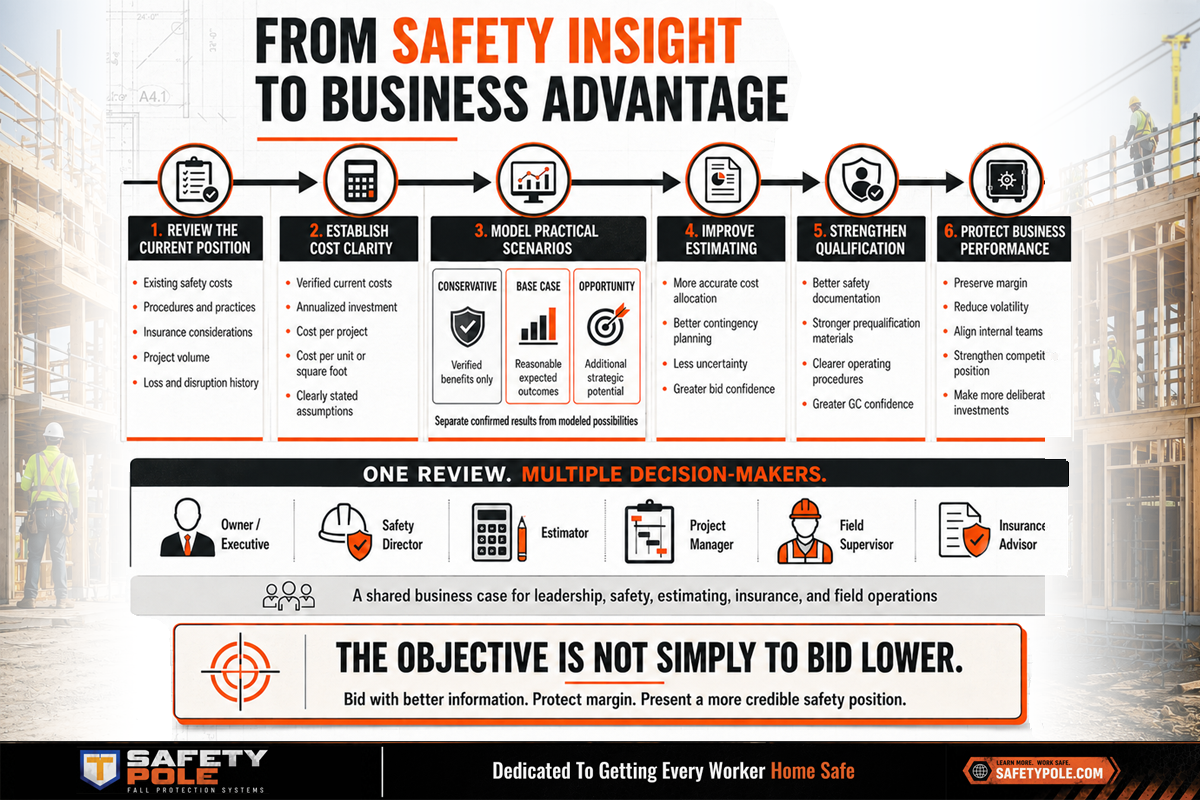
These two graphics outline the distinction between safety spending and safety investment, as well as the questions a structured Safety Investment Review can help examine.
Why is Safety Pole different?
Planned anchorage. Not just a tie-off point
Safety Pole gives the project team a physical system around which usable anchorage can be planned.
One modular system. Multiple deployment approaches.
Single Anchor and HLL applications are different ways of deploying the same Safety Pole System family rather than unrelated product solutions.
Protection that can progress with the work
The system can be planned for defined stages of construction and, where the applicable configuration and project conditions permit, repositioned and re-established as the work progresses.
Equipment designed to be used again
Safety Pole is reusable operating equipment when it has been properly inspected, maintained and confirmed serviceable under current manufacturer guidance.
A visible, documentable control
Planning, installation, inspection, use, training and other field practices can be documented around an actual physical fall-protection system.
That gives contractors something concrete to work from internally—and something more specific to discuss when an owner, GC, safety professional, broker or other qualified evaluator asks how fall protection is being managed.
Start With the Work
Every project is different. The useful first conversation is not simply, “How many Safety Poles do I need?”
It is:
Where is the elevated work? How will the work progress? Where does usable anchorage need to be available? And what are you trying to solve?
If you are evaluating fall protection for an upcoming project, reviewing an existing approach or simply want to understand where Safety Pole may fit, tell us a little about the work.

Let's Talk About the Risk You're Managing

