Treat the Safety Pole acquisition value as a project-specific input
Safety Pole commercial pricing is not published in this public analysis.
For a specific project or purchasing decision, obtain the applicable Safety Pole acquisition information directly from Safety Pole and use that value in your own evaluation.
That keeps two different questions separate:
What does my current operating method cost?
and
What is the project-specific Safety Pole investment I am comparing it with?
Once both sides are known, the comparison can be built from actual inputs rather than a generic public price example.
Purchase price is not the same as total cost
The acquisition value is important, but it is not automatically the complete economic picture.
A full analysis may need to account for other applicable ownership and operating costs, the incumbent costs that remain, and the amount of work the equipment is expected to support over the selected evaluation period.
That distinction prevents a common mistake: treating the day-one purchase order as if it were the entire cost of using the system.
It also prevents the opposite mistake: treating every cost associated with the existing method as if it will disappear.
Both sides of the comparison need the same discipline.
Look at the investment across the work it may support
Safety Pole is evaluated here as capital equipment rather than as a one-project consumable.
If the equipment is redeployed across additional projects, the acquisition decision can be considered across the production the equipment actually supports during the selected evaluation period.
That creates several useful management questions:
- How much protected or framed production will the equipment support during the period we are evaluating?
- What does the equipment investment represent per protected square foot when we use our own acquisition value?
- Which incumbent cost categories changed after deployment?
- Which costs remained?
- What new applicable costs appeared?
- Did utilization match the original plan?
Those questions are more useful than asking whether the equipment was simply expensive or inexpensive on the day it was purchased.
Keep the safety program and the capital model separate
Safety Pole does not replace your safety program.
Your people, training, supervision, inspections, PPE, procedures, and project-specific fall-protection planning remain part of the larger safety process.
The capital-investment analysis has a narrower job: determine what changed in the operating cost structure associated with the work being evaluated.
That keeps the business case from trying to prove more than the records can support.
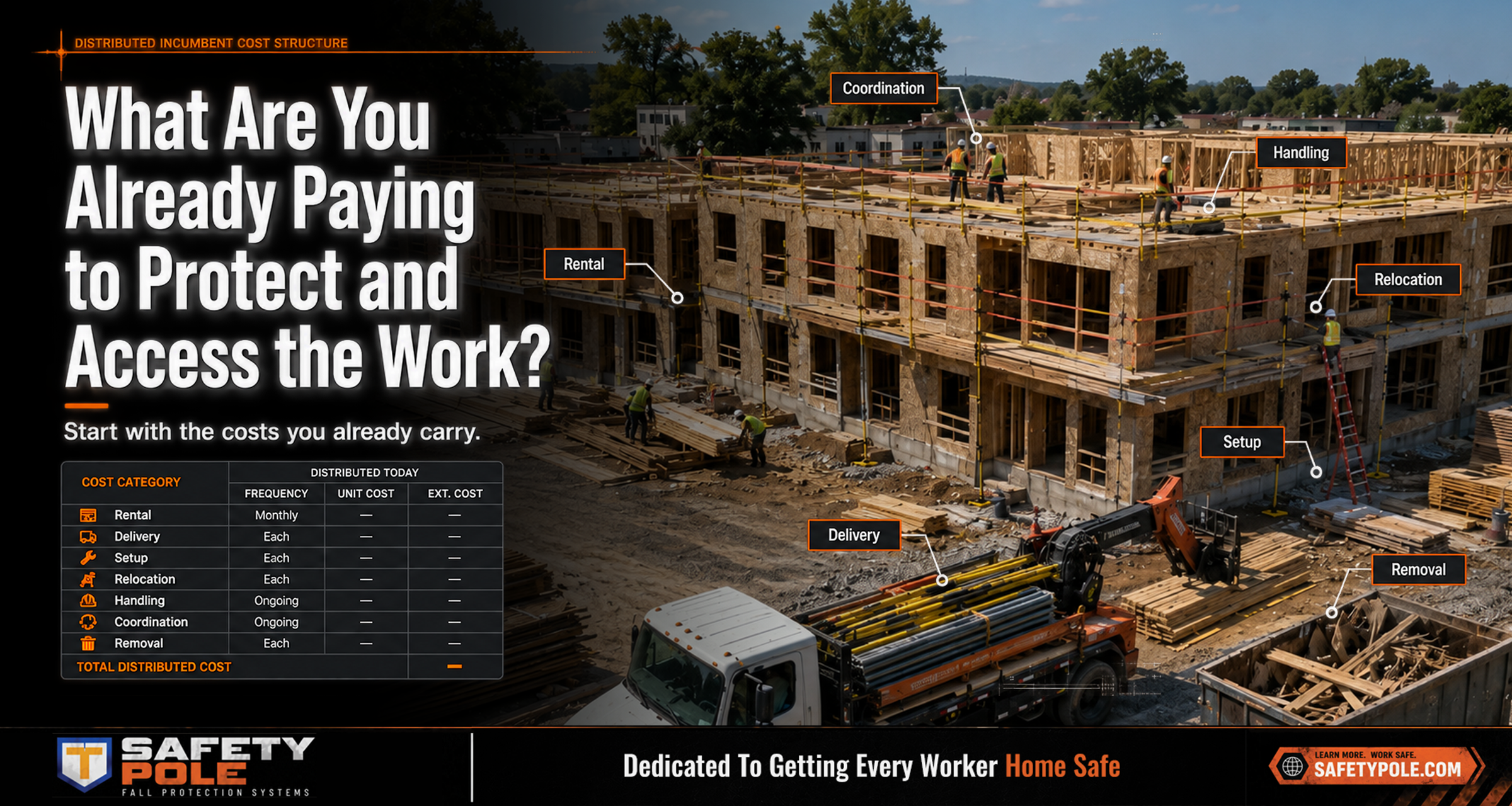
Start with the costs you already carry
If you are considering a Safety Pole investment, begin by assembling the incumbent cost picture before trying to reach a conclusion about return, savings, or payback.
Document what you spend now. Identify what would remain. Identify what could change. Add the operating costs that belong to the new method. Then obtain the project-specific Safety Pole acquisition value and evaluate the two approaches on the same basis.
That is the foundation for the next step in the series: putting the investment against the amount of work you expect it to support.
Safety Pole, Inc.
Start with the costs you already carry. Then evaluate the investment against the work.