A Conversation About Business Risk
Insurance is part of the risk strategy. So is what happens before there is a loss to insure.
For contractors, fall risk is not only a safety-department concern.
It can touch operations, project planning, retained costs, management attention, documentation, insurance conversations and—when an incident occurs—potential disruption to the work.
That makes fall protection part of a larger business-risk discussion.
The useful place to begin is not with a promise about premiums, claims or outcomes.
It is with a more practical question:
What exposure does the work create, and what are you doing to control it?
Control the Exposure Before You Talk About the Outcome
Fall Protection
That Provides
Proof of Practice
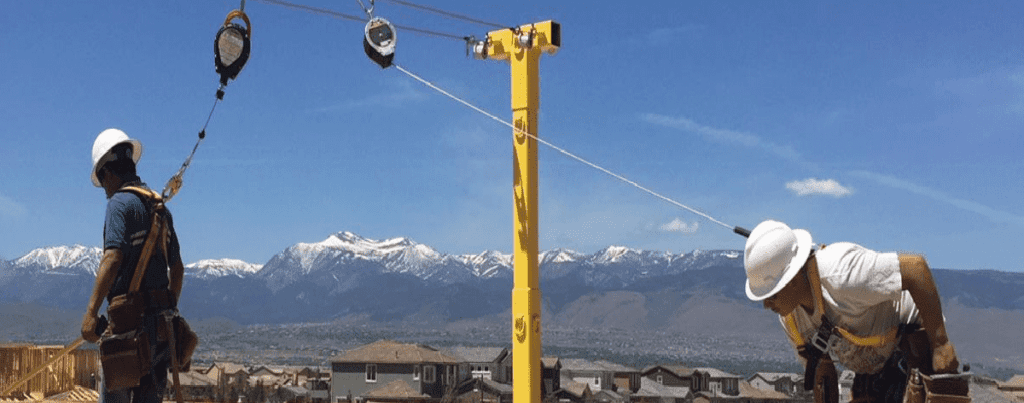
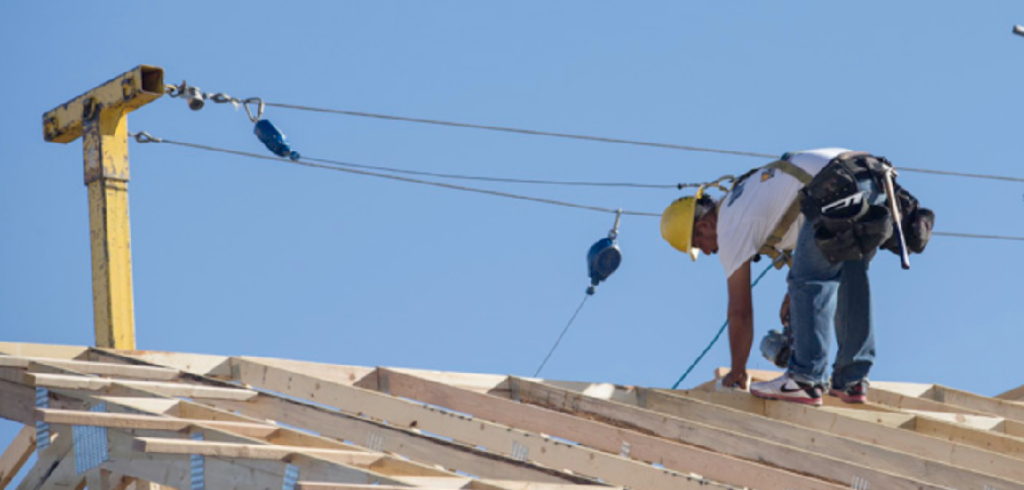
Safety Pole provides planned fall-protection anchorage that can be incorporated into the way construction work is organized.
That makes it one physical control within a much larger risk-management picture.
A contractor may still need to consider:
- the construction sequence;
- fall-protection planning;
- training, inspection and supervision;
- scaffold and access requirements;
- project-specific retained costs;
- operational disruption;
- insurance and contractual risk transfer; and
- documentation of what was actually done.
Safety Pole does not control all of those outcomes.
What it can provide is a defined physical system around which part of that risk can be planned, implemented and documented.
Why That Matters to the Business
Plan the control earlier
Fall protection can be considered during estimating, preconstruction and sequencing, before elevated exposure develops in the field.
Make the practice visible
A physical system gives management something concrete to inspect, verify and document.
Connect safety with operations
Anchorage planning, work sequence, crew movement, access and certain scaffold requirements can be considered together rather than as unrelated problems.
Understand what the business still retains
Insurance may transfer or finance portions of risk. It does not remove the need to manage the underlying exposure.
Deductibles, internal administration, management time, operational consequences and other retained exposures may still matter to the contractor.
Give risk professionals better information
When fall-protection practices are specific and documented, owners, GCs, brokers, carriers and other qualified evaluators can have a more informed conversation about what the contractor is actually doing.
That does not guarantee a premium reduction, lower EMR, claim outcome, prequalification result or other third-party decision.
It does give the conversation something more concrete to evaluate.
Examine the Business Value Behind Your Safety Program
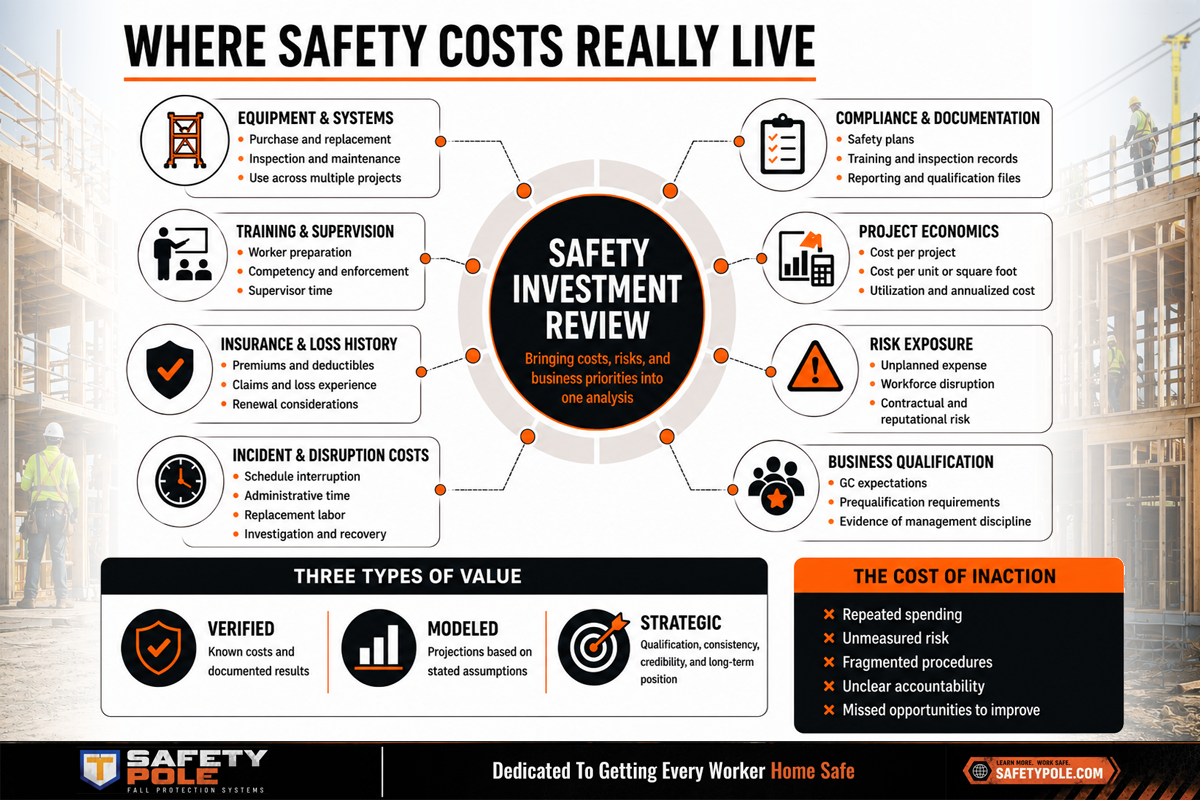
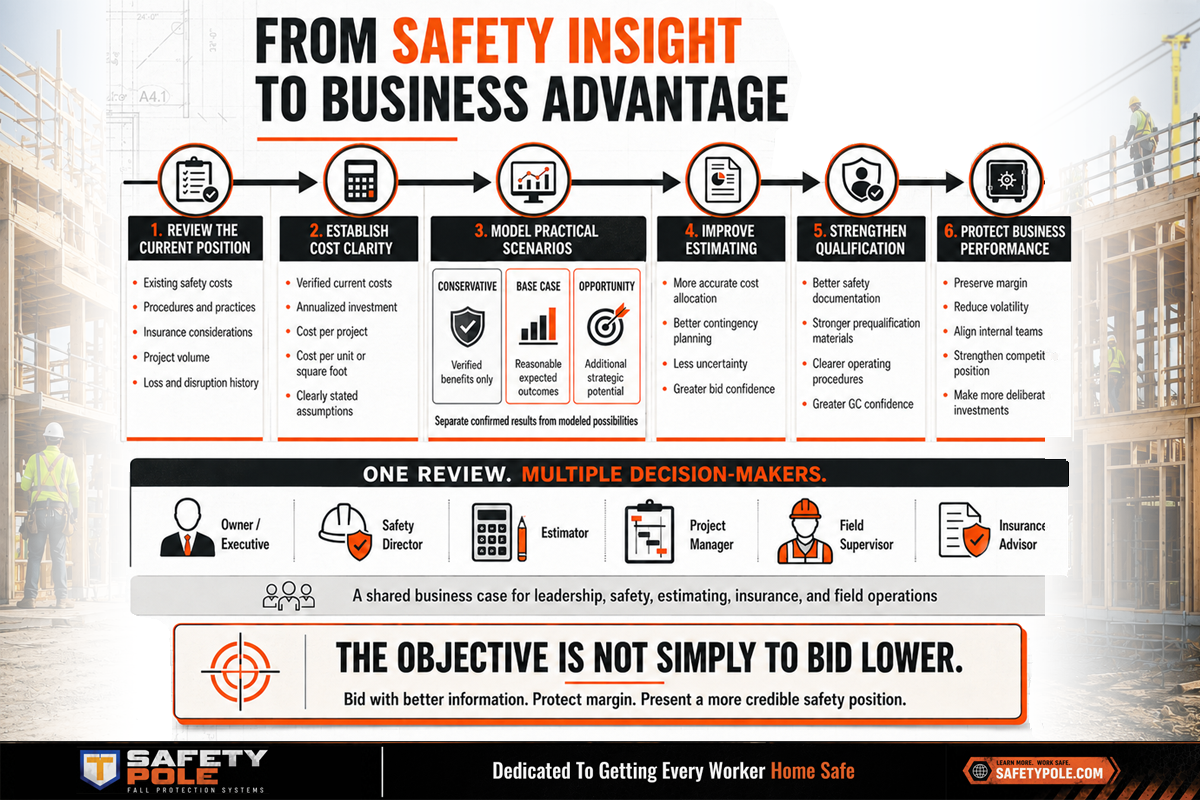
These two graphics outline the distinction between safety spending and safety investment, as well as the questions a structured Safety Investment Review can help examine.
A Different Way to Ask the Question
Instead of starting with:
“What does fall protection cost?”
It can be useful to also ask:
- Where does the exposure occur?
- How will the work change?
- What physical controls are planned?
- What does the company retain if something goes wrong?
- What practices can actually be shown and documented?
- What assumptions are already built into the estimate, access plan and construction sequence?
Those questions move fall protection from an equipment conversation toward a broader project and business-risk discussion.
Where Insurance Fits
Insurance remains an important part of managing business risk.
But insurance and physical risk control serve different purposes.
Safety Pole does not determine your premium, coverage, underwriting treatment, EMR or claim outcome.
What Safety Pole can help you discuss is the operating side of the risk:
How is the exposure being controlled before the conversation reaches the policy, the claim or the evaluator?
When appropriate, those conversations can also involve your broker, insurance adviser or other qualified risk professional.
Bringing the Right People Into the Conversation
Business risk rarely belongs to one department.
Fall protection may begin as a field and safety question, but the discussion can quickly involve operations, estimating, finance, ownership and insurance.
Safety Pole’s role is to address the physical-control and planning side of that conversation: where elevated exposure occurs, how usable anchorage can be planned into the work, how the system is implemented and how actual practice can be documented.
Insurance professionals bring a different perspective.
A broker or other qualified risk adviser can help the contractor understand how its insurance program, retained risk, loss experience and broader risk-management practices fit together.
Those roles are related, but they are not interchangeable.
Safety Pole does not determine premiums, coverage, underwriting treatment, EMR or claim outcomes.
What Safety Pole can help provide is a clearer picture of the operational control itself; something the contractor and its risk advisers can discuss using actual project conditions and documented practice.
Through initiatives involving Baldwin Insurance, Safety Pole is working to encourage that broader conversation: connecting the way risk is controlled in the field with the way contractors evaluate and communicate business risk.
The objective is not to promise an insurance result.
It is to make sure the right questions—and the right people—are part of the discussion.
Start With the Work
You do not need to have a complete risk model—or even know exactly which Safety Pole configuration you need—to begin the conversation.
Tell us what kind of work you are doing, where elevated exposure occurs and what questions you are trying to answer.
We can start there.
Let's Talk About the Risk You're Managing